
Stone chips, light scratches and everyday road debris can gradually affect a vehicle's original paint.
Paint protection film provides an additional physical layer designed to help reduce that damage.
But what exactly is PPF, how does it work, and how much protection can it realistically provide?
This guide explains the technology, construction, benefits and limitations of modern automotive paint protection film, with practical considerations for drivers in Malaysia.
The essentials
Key takeaways
Paint protection film is a physical barrier.
Modern PPF is generally made from flexible thermoplastic polyurethane and applied over suitable automotive exterior surfaces.
It protects by taking some of the impact.
The film acts as a sacrificial layer that can reduce certain stone-chip marks, light abrasion and everyday wear reaching the paint.
Self-healing applies to specific surface marks.
Fine scratches in a suitable self-healing topcoat may recover under appropriate heat conditions. Deep cuts and punctures do not automatically repair themselves.
PPF and ceramic coating are different.
PPF provides a protective film barrier, while ceramic coating primarily improves surface characteristics such as gloss, hydrophobic performance and cleaning convenience.
Coverage and installation matter.
A quality film, correctly fitted to the relevant panels and maintained according to its instructions, is more useful than choosing based on film thickness alone.
01 — WHAT IS PAINT PROTECTION FILM?
A Clear Layer Between the Road and Your Paint.
Paint protection film (PPF) is a flexible, transparent or coloured protective film applied to suitable exterior vehicle surfaces to help reduce damage from stone chips, minor scratches, abrasion and everyday road exposure.
Modern automotive PPF commonly uses thermoplastic polyurethane, abbreviated TPU, as a principal protective layer.
Once professionally installed, the film forms a physical barrier over the covered surface.
Rather than allowing every minor impact to contact the clearcoat directly, the film takes some of that contact first.
That is the fundamental difference between paint protection film and many liquid-applied surface treatments.
A ceramic coating forms a comparatively thin protective surface layer.
PPF is a separate sheet of material with measurable physical thickness.
It is engineered to provide a degree of impact and abrasion protection that a conventional ceramic coating is not designed to replace.
The film can be used on selected panels or across a much larger portion of the exterior.
Common areas include the front bumper, bonnet, front fenders, side mirrors, door cups, doors and rear body panels.
Modern PPF is also available in coloured finishes, although clear film remains a common choice for owners who want to preserve their vehicle's existing paint colour.
Is PPF the Same as a Car Wrap?
Not necessarily.
A conventional decorative vinyl wrap is primarily intended to change or customize a vehicle's appearance.
Automotive paint protection film is primarily engineered to add physical surface protection.
Colour PPF combines aesthetic customization with protective-film characteristics, but its material construction and specific performance depend on the product.
The terms should not be used interchangeably.
02 — HOW DOES PPF ACTUALLY PROTECT A CAR?
Protection Begins With a Physical Barrier.
Paint protection film works by placing a resilient, flexible material between a vehicle's painted surface and certain external hazards.
When small stones, grit or debris contact a covered panel, the film is the first material exposed to that contact.
Its structure can deform under certain impacts and help distribute some of the force across the film rather than allowing it to act directly on the paint.
This can reduce the likelihood or severity of some surface damage.
It does not mean the force disappears.
A sufficiently sharp, large or high-energy impact can penetrate or tear the film and still damage the underlying paint.
1. Impact Resistance
Road debris can strike the bonnet, bumper and other forward-facing panels during normal driving.
TPU-based PPF provides a physical layer designed to help absorb and distribute some of these impacts.
This is particularly relevant during highway driving, where debris may be thrown up by other vehicles.
The protective outcome depends on the debris, impact energy, angle, film properties and installation condition.
2. Abrasion Resistance
Painted surfaces can develop fine marks through contact with road grit, washing materials and everyday objects.
A protective film can help reduce direct abrasion of the original clearcoat.
Some light marks will affect the film's surface instead of the paint beneath it.
However, PPF is not abrasion-proof, and improper washing can still damage the protective surface.
3. Surface Recovery
Certain premium PPF products use self-healing topcoats.
Under appropriate temperature conditions, some fine surface marks can become less visible as the topcoat relaxes toward its original surface shape.
This is a property of the film's surface material.
It does not mean damaged vehicle paint will heal.
4. Environmental Exposure
The film also separates the covered paint from some environmental contaminants.
Road grime, insect residue, bird droppings and other deposits may land on the film rather than directly on the paint.
That can reduce direct exposure of the protected surface, but contaminants still need to be removed promptly.
Strong chemicals, prolonged exposure and improper maintenance can damage or stain protective films.
5. Easier Cleaning
Many modern films have hydrophobic surface properties that encourage water to bead and move across the surface.
This can help make routine washing more convenient.
It does not eliminate dirt, mineral deposits or water spotting.
Regular washing and careful drying remain necessary.
The Important Limitation
PPF is best understood as a damage-reduction layer, not a guarantee against damage.
Its real value comes from protecting the original finish against selected everyday hazards while helping reduce the need for paint repair.
03 — WHAT IS PPF MADE FROM?
Understanding the Layers of a Modern Protective Film.
A typical premium TPU paint protection film uses several functional layers.
The precise construction varies between manufacturers and film series.
Not every manufacturer uses an identical layer count, material formula or surface treatment.
Layer 1 — Protective Topcoat
The outer surface determines many of the film's visible and maintenance-related characteristics.
Depending on the product, it may provide high-gloss or matte appearance, stain resistance, hydrophobic behaviour and self-healing characteristics.
The topcoat is also the part of the film most directly exposed to washing and fine contact marks.
Layer 2 — Thermoplastic Polyurethane Core
The TPU body provides much of the film's physical thickness, flexibility and resilience.
Its ability to stretch and conform to complex automotive panels makes it suitable for curved bonnets, bumpers, fenders and other shaped surfaces.
The TPU core also contributes to the film's response to impacts and abrasion.
Thickness matters, but greater thickness alone does not establish that one film performs better than another.
Layer 3 — Adhesive System
A transparent bonding layer secures the film to a compatible prepared surface.
The adhesive system is important for film positioning, adhesion, appearance and appropriate removal.
Poor preparation, unsuitable application or incorrect removal can contribute to lifting, adhesive residue or damage.
Professional assessment is especially important when the vehicle has repainted panels or existing paint defects.
Layer 4 — Release and Protective Liners
Protective liners help preserve the film and adhesive during manufacturing, storage, handling and installation.
These liners are removed during the application process.
They are not additional protective layers left permanently on the vehicle's paint.
Film Construction at a Glance
| Component | Primary role |
|---|---|
| Surface topcoat | Appearance, self-healing and surface characteristics, depending on film |
| TPU core | Physical barrier, flexibility and impact-related protection |
| Adhesive | Bonding the film to the prepared vehicle surface |
| Release/protective liners | Protecting material during handling; removed during fitting |
This table describes a representative construction, not the exact proprietary composition of every PPF product.
The finished system must be assessed as a whole.
Film chemistry, topcoat performance, adhesive quality, installation and maintenance all contribute to the result.
04 — WHAT DOES PPF PROTECT AGAINST?
Understanding the Benefits Without Overstating Them.
Paint protection film can be a valuable option for owners who want to preserve their vehicle's original finish.
However, different hazards affect vehicles in different ways.
Stone Chips
PPF can help reduce damage from certain small stones and road debris.
Its physical barrier is especially relevant on forward-facing panels.
Heavy impacts and sharp stones can still penetrate the film.
Fine Scratches and Swirls
Some films can reduce direct scratching of the paint, while suitable self-healing topcoats may recover from certain superficial marks.
Deep cuts, punctures and extensive abrasion are not self-healing.
Insect Residue and Bird Droppings
The film provides a separation layer between contaminants and the covered paint.
Nevertheless, these deposits can still affect the film's surface if neglected.
Prompt cleaning is recommended.
Road Grime and Rain
PPF can reduce direct exposure of covered paint to road grime and contaminants.
Hydrophobic surface technology may make cleaning easier, depending on the product.
It does not prevent every watermark or stain.
Light Incidental Contact
Some minor rubbing or contact may affect the film rather than the underlying paint.
However, door impacts, scraping against hard objects or collisions can still cause significant damage.
UV and Weather Exposure
Some PPF products incorporate UV-related protective characteristics intended to support film stability and reduce certain forms of environmental exposure.
The exact performance depends on the film and supporting manufacturer data.
PPF should not be claimed to block all UV radiation or prevent every type of paint fading without product-specific evidence.
Protection Capability Table
| Everyday hazard | What PPF can do | Important limitation |
|---|---|---|
| Small road stones | Help absorb selected impacts | Severe impacts may penetrate |
| Light swirls | Reduce direct paint abrasion; some topcoats self-heal | Deep scratches remain possible |
| Road grit | Provide an additional abrasion barrier | Film itself can become marked |
| Bird droppings | Separate contamination from covered paint | Film can still stain |
| Rain and road grime | Support more convenient cleaning on suitable films | Washing remains necessary |
| Door contact | Reduce some minor surface contact damage | Hard impacts can damage paint |
| Strong chemicals | Varies by film and exposure | Chemical damage remains possible |
| Collisions | Not designed as collision protection | Bodywork can still be damaged |
PPF is protective, not indestructible.
05 — HOW DOES SELF-HEALING PPF WORK?
Why Some Fine Scratches Can Disappear.
Self-healing is one of the most recognizable features of premium paint protection film.
The term refers to the ability of certain film surface materials to recover from some fine marks.
When a light swirl or superficial scratch affects a suitable topcoat, the material may relax and recover under favourable temperature conditions.
Warmth can help this process.
Depending on the film, it may occur through environmental heat or another manufacturer-approved method.
The result depends on the depth of the mark, the material and the conditions.
What Self-Healing Can Help With
- Certain superficial swirl marks.
- Some fine washing-related marks.
- Minor marks limited to the self-healing surface layer.
What Self-Healing Cannot Repair
- Deep cuts through the film.
- Punctures.
- Missing or torn film material.
- Severe abrasion.
- Damaged or chipped original paint.
- Delamination or other film failure.
Do not deliberately apply excessive heat, boiling water or unapproved tools to force a repair.
A deeply damaged film should be evaluated by a professional installer.
For a more detailed explanation, read How Self-Healing PPF Works.
06 — PPF VS CERAMIC COATING: WHAT IS THE DIFFERENCE?
Two Technologies. Different Jobs.
Paint protection film and ceramic coating are often discussed together.
They can complement one another, but they do not provide identical protection.
PPF is a physical film installed over compatible surfaces.
Ceramic coating is a liquid-applied protective treatment that cures to form a comparatively thin surface layer.
The primary advantage of PPF is its physical barrier against selected impacts and abrasion.
The primary advantages of ceramic coating include surface characteristics such as water repellency, gloss, environmental resistance and easier maintenance.
PPF vs Ceramic Coating
| Feature | Paint Protection Film | Ceramic Coating |
|---|---|---|
| Physical sheet of material | Yes | No |
| Protection against selected stone chips | Designed for this purpose | Not equivalent to PPF |
| Self-healing | Available on suitable films | Not equivalent to PPF self-healing |
| Water repellency | Available on many films | Major coating characteristic |
| Gloss enhancement | Depends on film finish | Often a major benefit |
| Physical thickness | Measured in microns/mils | Much thinner surface treatment |
| Maintenance required | Yes | Yes |
| Scratch-proof | No | No |
Can They Be Used Together?
Yes, when the particular products and installation procedures are compatible.
For example, a driver may use PPF on higher-impact panels and a ceramic coating on other compatible surfaces.
Some modern protective films also integrate ceramic-related surface technology.
That does not mean all PPF products require a separate coating.
The decision should be based on the selected film, its surface characteristics, manufacturer guidance and the vehicle owner's priorities.
Further reading: PPF vs Ceramic Coating.
07 — WHAT TYPES OF PPF ARE AVAILABLE IN MALAYSIA?
Different Films for Different Ownership Needs.
Not every protective film is engineered for identical requirements.
Film thickness, surface technology, optical finish, self-healing characteristics, package coverage and warranty support can vary.
Ceramic Pro Malaysia offers several film systems designed for different protection preferences.
Ceramic Pro Urban PPF
Everyday physical protection.
Ceramic Pro Urban is a clear, self-healing TPU paint protection film designed for everyday driving.
It provides a physical barrier against selected road debris, stone chips and minor surface damage.
The published product information describes:
- Approximately 7 mil / 185 microns nominal thickness.
- Self-healing surface characteristics.
- Clear protective appearance.
- Three-year warranty against specified manufacturing defects.
Urban can be considered by drivers who want practical physical paint protection on selected panels or across broader exterior areas.
Ceramic Pro Composite Protection Film (CPF)
Physical film protection with ceramic surface technology.
Ceramic Pro CPF combines the physical barrier of paint protection film with the manufacturer's Flexible Ceramic Composite Technology (FCCT) and ION-related ceramic surface technology.
The film system is designed to provide physical protection together with advanced surface characteristics.
Published information includes:
- Approximately 8 mil / 205 microns nominal thickness.
- Flexible Ceramic Composite Technology.
- ION-based ceramic surface technology.
- Hydrophobic and self-healing characteristics.
- Five-year warranty against specified manufacturing defects.
- Five complimentary maintenance sessions under the applicable package terms.
These technologies should be described using the manufacturer's documented terminology.
Ceramic Pro Composite Protection Film
Magnus Pro Paint Protection Film
Flagship multi-layer film protection.
Magnus Pro's featured paint protection film is designed around physical protection, self-healing surface performance and optical clarity.
The Malaysian product information identifies:
- Featured film thickness of 8.5 mil / approximately 215 microns.
- Self-healing properties.
- Hydrophobic surface characteristics.
- A six-year warranty against specified manufacturing defects.
- Multiple coverage options.
Specific construction and thickness can vary by film variant.
Do not assume every Magnus Pro film has identical specifications.
Magnus Pro Paint Protection Film
Colour Paint Protection Film
Clear PPF is designed to preserve the underlying paint appearance.
Colour PPF can provide a different visual finish while also incorporating protective-film characteristics.
Ceramic Pro SHIFT Color PPF is the relevant example within the Malaysian product range.
Colour PPF should not automatically be treated as the same material or protective system as conventional decorative vinyl wrap.
Choosing Among the Films
There is no universally correct choice based only on thickness.
A suitable film should be assessed according to:
- The level of physical protection required.
- The panels needing coverage.
- Driving and parking conditions.
- Product-specific surface technology.
- Installation expertise.
- Maintenance requirements.
- Verified warranty terms.
- Vehicle-specific quotation.
This guide explains what PPF does.
The detailed product pages explain the differences between the available systems.
08 — WHICH PPF PACKAGE SHOULD YOU CHOOSE?
Protect the Areas That Matter Most.
Paint protection film does not need to cover an entire vehicle to provide useful benefits.
Some owners prioritize the most exposed front-facing areas.
Others prefer wider exterior coverage.
BASIC
BASIC packages typically target selected front-end and everyday-contact areas.
Published examples include the front bumper, headlamps, side mirrors and door cups.
This is a practical option when the owner wants focused protection without covering major additional panels.
ADVANCE
The ADVANCE package is offered within the Magnus Pro PPF range.
It extends the applicable BASIC coverage by adding the bonnet.
Do not suggest ADVANCE is available for every Ceramic Pro film series.
FULL FRONT
FULL FRONT focuses on major front-facing areas.
Depending on the film series and approved package, it can include the bonnet, front bumper, front fenders, headlamps, side mirrors and related specified areas.
This may suit drivers who frequently travel on highways or are particularly concerned about front-end road debris.
FULL WRAP
FULL WRAP extends protective film coverage across a larger portion of the exterior.
Published coverage can include doors, rear quarters, rear bumper, rocker panels, tailgate and other approved areas.
The exact panel list varies by film series and vehicle design.
A full wrap does not automatically mean the windscreen, panoramic glass roof, interior surfaces or every trim component is protected.
Those surfaces may require separate products or specific installation approval.
Coverage Comparison
| Package | Typical purpose | Coverage approach |
|---|---|---|
| BASIC | Selected high-contact and front-impact areas | Targeted |
| ADVANCE | BASIC plus bonnet | Magnus Pro series |
| FULL FRONT | Major front-facing painted panels | Broader front protection |
| FULL WRAP | Wider vehicle exterior protection | Comprehensive approved coverage |
What Is Best for Malaysian Driving?
For frequent highway travel, front-facing protection is a reasonable starting point.
For a new vehicle where preserving more of the original finish is a priority, wider coverage may be worth considering.
For owners who mainly want enhanced gloss and easier washing, ceramic coating may also be relevant.
The right package depends on the vehicle, driving habits, budget and desired coverage.
For current package comparisons, read PPF Price in Malaysia.
09 — HOW IS PAINT PROTECTION FILM INSTALLED?
Film Performance Also Depends on Workmanship.
Protective film must be fitted to the contours and surfaces of a real vehicle.
That makes installation quality an important part of the finished result.
The exact professional procedure varies by film manufacturer, vehicle and installation system.
A typical installation involves several stages.
Surface Assessment
The vehicle is inspected for existing defects, paint repairs, contamination and surfaces that may not be suitable for film application.
PPF is transparent or colour-specific protective material. It does not automatically conceal existing defects.
Cleaning and Preparation
Suitable preparation helps remove dirt, residue and contamination before the adhesive contacts the surface.
The degree of decontamination or paint correction needed depends on the actual paint condition.
Film Preparation
Film may be prepared using suitable vehicle-specific patterns or another manufacturer-approved professional process.
Do not assume that all installations use the same cutting technology.
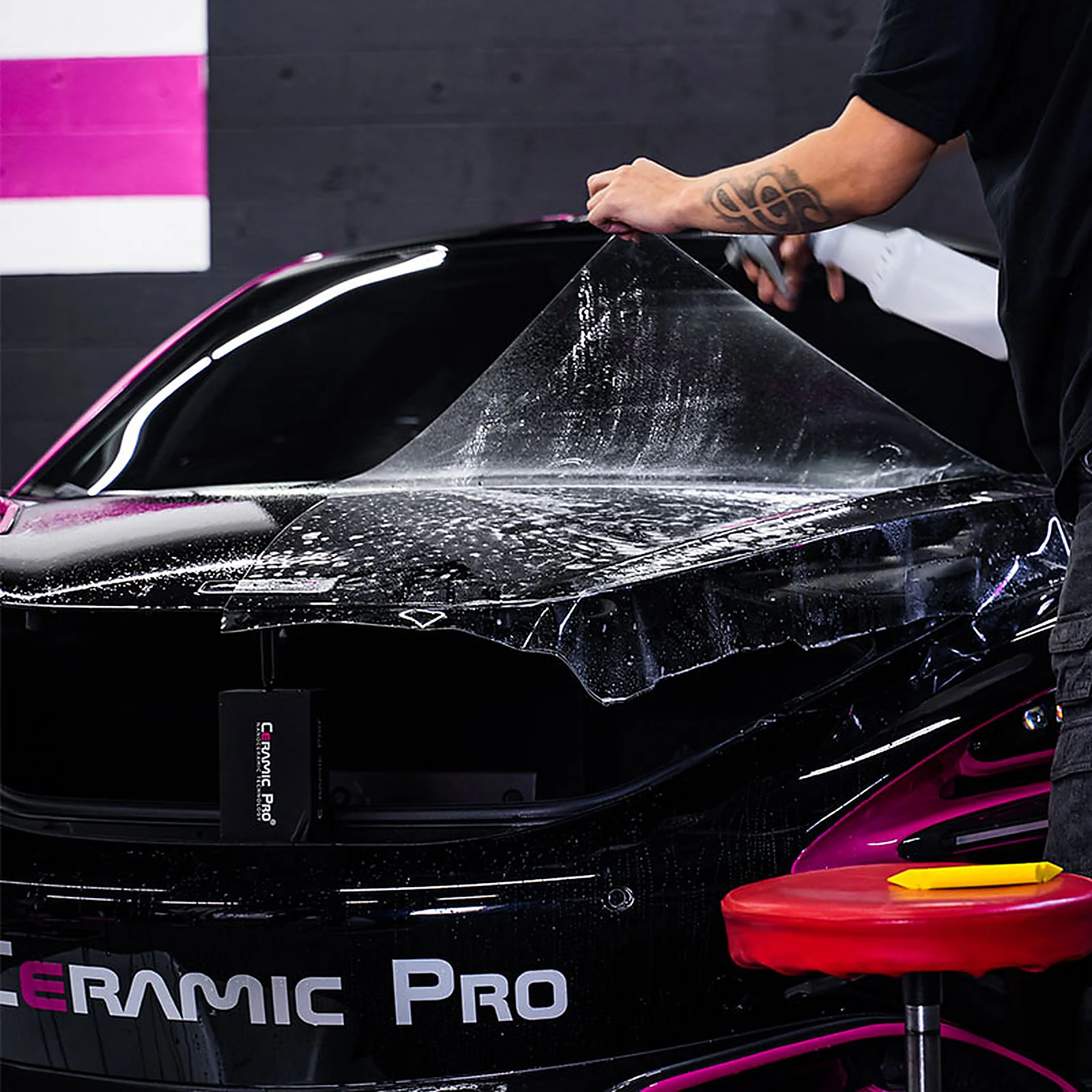
Positioning and Application
The film is carefully placed over the prepared panel.
Depending on the product and procedure, approved application solutions and installation tools may be used to position the film and manage trapped moisture.
Edges and Inspection
The installer checks alignment, edge finishing, adhesion, appearance and visible imperfections.
Complex areas such as bumpers, curved fenders and panel transitions require particular attention.
Settling Period
Freshly installed film may require a settling period.
Some temporary appearance changes can occur as residual moisture and the adhesive system stabilize.
However, persistent abnormal bubbling, peeling, lifting or contamination should be inspected professionally.
Do not describe all visible bubbles as normal without qualification.
Why Installation Experience Matters
Film quality alone cannot compensate for unsuitable preparation, incorrect procedures or poor fitting.
A vehicle-specific assessment and clear coverage schedule are important parts of a professional PPF service.
For real installation examples, explore Garage Journal.
10 — HOW LONG DOES PPF LAST, AND HOW SHOULD YOU MAINTAIN IT?
Good Protection Still Needs Proper Care.
The actual service life of paint protection film depends on the specific product, installation, environmental exposure and maintenance.
A film warranty period is not the same as a guarantee that the film will remain visually perfect or damage-free for that entire period.
Understanding Warranty Coverage
Ceramic Pro Malaysia publishes different warranty periods for its film ranges:
| Film | Published warranty period |
|---|---|
| Ceramic Pro Urban PPF | 3 years |
| Ceramic Pro CPF | 5 years |
| Magnus Pro featured PPF | 6 years |
These warranties relate to specified manufacturing defects and are subject to applicable conditions.
Examples may include qualifying cracking, hazing, blistering or delamination.
They do not automatically cover accidental impacts, collisions, misuse, deep cuts or damage caused by improper maintenance.
Warranty eligibility should always be checked against the official terms and installation record.
PPF Aftercare Essentials
- Follow the installer and film manufacturer's initial washing restrictions.
- For Ceramic Pro CPF, the published guidance recommends avoiding washing for the first seven days.
- Wash using a suitable pH-balanced automotive shampoo.
- Use clean microfiber materials and gentle washing techniques.
- Remove bird droppings, insect residue and tree sap promptly.
- Avoid aggressive chemicals and abrasive cleaning equipment.
- Keep high-pressure water jets away from exposed film edges.
- Do not pull, scrape or attempt to repair lifting edges yourself.
- Dry the vehicle carefully to reduce water spotting.
- Arrange professional inspection if the film develops abnormal defects.
Different products may have different care instructions.
Always follow the instructions applicable to the film actually installed.
Can PPF Be Removed?
Yes, professionally installed automotive PPF can generally be removed using appropriate procedures.
However, paint condition, previous repairs, adhesive age and removal technique matter.
On repainted or poorly bonded surfaces, removal can carry a risk of paint damage.
Professional removal is recommended.
Does PPF Eliminate Car Washing?
No.
Hydrophobic behaviour can support easier cleaning, but it does not make a car maintenance-free.
For routine care, owners may also explore Auto Bath Club where the selected service is appropriate for their vehicle's protective film.
Auto Bath Club membership or washing there is not mandatory for warranty validity.
11 — IS PPF WORTH IT FOR MALAYSIAN CAR OWNERS?
Choose Protection Based on Real Exposure.
Malaysia's driving environment presents several practical considerations for vehicle paint.
Highway travel can expose front-facing panels to loose stones and other debris.
Frequent rain can introduce road spray, grime and environmental contamination.
Outdoor parking exposes the exterior to changing temperature, sunlight and contaminants.
In urban settings, crowded parking and repeated daily contact can also affect exposed surfaces.
PPF is worth considering when protecting the original paint is a priority.
It may be particularly relevant for:
New-car owners: who want to protect the factory finish before significant everyday wear develops.
Frequent highway drivers: whose front-end panels face repeated road-debris exposure.
Owners of premium or enthusiast vehicles: who place particular value on preserving original exterior appearance.
Long-term owners: who want to reduce selected paint-related damage over years of driving.
Owners comparing partial and full-body protection: who want to understand the practical difference between coverage packages.
However, PPF is an investment.
Not every driver requires Full Wrap, and not every film system has the same characteristics.
A smaller package may be sufficient for some vehicles.
A ceramic coating may be more appropriate when the primary priority is gloss and easier cleaning rather than physical impact protection.
The best decision comes from understanding the actual protective mechanism and matching it to the owner's needs.
12 — THE FINAL ANSWER
Protection You Can Understand.
Paint protection film works because it adds a physical protective material between selected vehicle surfaces and certain hazards encountered during driving.
A modern TPU-based film can help absorb some minor impacts, reduce direct abrasion and preserve the original paint beneath it.
Advanced film systems may also incorporate self-healing and hydrophobic characteristics.
These features can improve the ownership experience, but none makes a vehicle immune to damage.
Film construction matters.
So do installation quality, coverage selection and regular maintenance.
For Malaysian drivers, the most useful starting point is to identify the panels at greatest risk and understand the differences between available films.
Ceramic Pro Urban, Ceramic Pro CPF and Magnus Pro PPF offer different combinations of film thickness, surface technology and warranty coverage.
The right system depends on what you want to protect and how you use your vehicle.
The purpose of PPF is simple: help preserve the paint you already have.
Frequently Asked Questions About Paint Protection Film
REAL CARS. REAL PROTECTION.
Understanding how paint protection film works is one part of choosing the right protection. Seeing how it is installed on actual vehicles provides another perspective.
Explore real Ceramic Pro and Magnus Pro protection projects, including professional film fitting, vehicle-specific coverage and finished exterior results.
Explore Garage Journal. Arrange a vehicle-specific assessment through our approved locations. Explore Paint Protection Film.