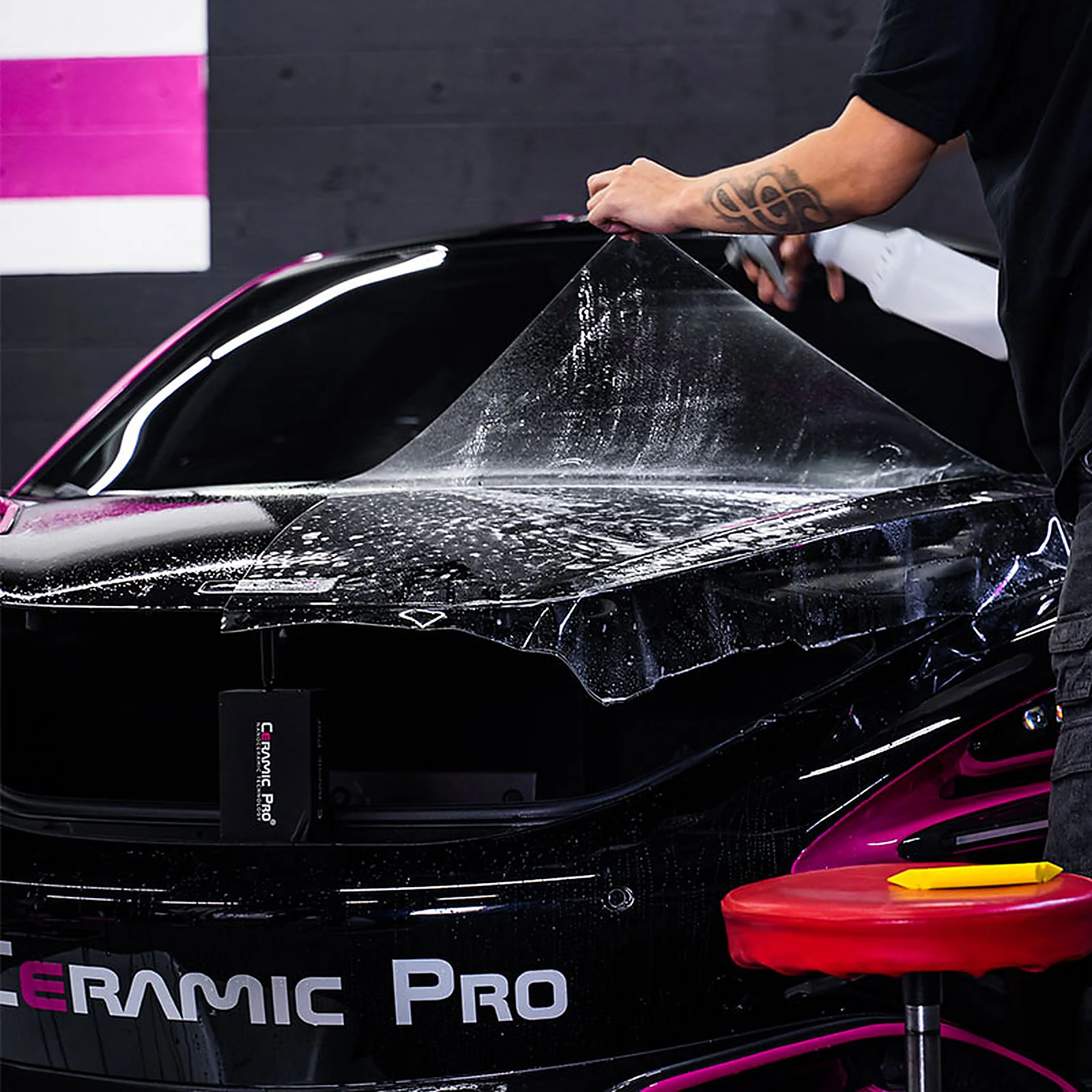

The best Paint Protection Film (PPF) is not necessarily the thickest. While thickness contributes to a film's physical construction, real-world protection also depends on material quality, top-coat technology, flexibility, installation and coverage.
For Malaysian drivers comparing PPF products, specifications such as 7 mil, 8 mil, 8.5 mil and 10 mil can be confusing.
A higher number may sound more impressive, but it does not automatically prove better paint protection.
Some protective films prioritise everyday driving performance and clear optical appearance.
Others combine multilayer protective technology with additional surface characteristics, such as self-healing and hydrophobic performance.
Ceramic Pro Malaysia offers three professional clear PPF systems: Ceramic Pro Urban PPF, Ceramic Pro Composite Protection Film (CPF) and Magnus Pro PPF.
The current published thicknesses are approximately 185 microns for Urban, 205 microns for CPF and 215 microns for Magnus Pro.
Each film is engineered around a different combination of protection technology and ownership benefits.
This guide explains PPF thickness in simple terms, compares common film measurements and shows what actually matters when choosing Paint Protection Film for your car.
1. What Is PPF Thickness?
PPF thickness refers to the physical thickness of the protective film.
It describes how much material makes up a particular measured film construction.
Paint Protection Film is applied over suitable automotive painted surfaces to create an additional protective barrier.
The film helps reduce damage from certain stone chips, minor scratches and everyday road debris.
Why Thickness Matters
A protective film provides material between the external environment and the original paintwork.
Thickness is one characteristic of that protective structure.
It may influence how the material responds to particular forms of mechanical contact, depending on its construction.
Why Thickness Is Not Everything
Two films with similar nominal thickness can use different materials, surface coatings, adhesive systems and manufacturing methods.
Their performance may therefore differ.
What Should Customers Compare?
Alongside thickness, consider:
- TPU material formulation.
- Layer construction.
- Self-healing surface technology.
- Optical clarity.
- Film flexibility.
- Hydrophobic characteristics.
- Verified protective performance.
- Professional installation.
- Warranty and aftercare.
- Vehicle coverage.
The Main Buying Principle
PPF thickness is a useful specification, but it must be considered as part of the complete protective film system.
2. What Does Mil Mean in Paint Protection Film?
A mil is a unit of thickness equal to one-thousandth of an inch.
It is frequently used when describing automotive protective films.
One mil is not the same as one millimetre.
Exact Unit Conversion
1 mil = 0.001 inch = 0.0254 millimetres = 25.4 microns.
A micron, also called a micrometre and represented by the symbol µm, is one-thousandth of a millimetre.
PPF Thickness Conversion Table
| PPF Thickness | Microns | Millimetres |
|---|---|---|
| 6 mil | 152.4 µm | 0.1524 mm |
| 7 mil | 177.8 µm | 0.1778 mm |
| 8 mil | 203.2 µm | 0.2032 mm |
| 8.5 mil | 215.9 µm | 0.2159 mm |
| 9 mil | 228.6 µm | 0.2286 mm |
| 10 mil | 254.0 µm | 0.2540 mm |
These are exact mathematical unit conversions, not measured specifications for particular products.
Why Some Product Figures Are Rounded
Manufacturers may publish approximate thicknesses in both mils and microns.
For instance, a film marketed as approximately 7 mil may have a published metric thickness slightly above 177.8 microns.
The underlying metric specification and rounding convention should be considered.
Is 8 Mil Equal to 8 Millimetres?
No.
An 8-mil PPF corresponds to approximately 0.203 millimetres, making it substantially thinner than an 8-millimetre material.
Why Understanding Units Helps
Using the correct units allows customers to compare product specifications more meaningfully.
Always check whether the thickness is expressed in mil, micron or millimetres before comparing films.
3. Is Thicker PPF Always Better?
No. A thicker PPF is not automatically the better film for every vehicle.
Thickness is one part of a much broader material design.
More Material Can Be Relevant
When other material properties are comparable, a thicker protective structure may provide additional material to respond to certain impacts.
However, this does not establish a universal performance ranking between unrelated products.
Material Technology Matters
Two PPF products can have different polymer formulations and protective layers.
These differences can influence their physical and surface characteristics.
Top-Coat Performance Matters
The upper surface of PPF helps determine characteristics such as self-healing, gloss and resistance to certain environmental contaminants.
A thicker film does not automatically have a better top coat.
Installation Matters
A professional installer must fit protective film across different body shapes and curves.
The suitability of the selected film depends on its flexibility, construction and installation requirements.
Optical Clarity Matters
A premium clear PPF should preserve a refined view of the underlying paint.
Thickness alone does not establish clarity, gloss or visual finish.
Coverage Matters
Even a thick protective film only protects the surfaces where it is installed.
Appropriate Full Front or Full Wrap coverage may be more relevant to an owner's needs than a small thickness difference.
Quick Comparison
| Buying Factor | Why It Matters |
|---|---|
| Thickness | Describes the film's physical build |
| Material construction | Influences protective behaviour |
| Top coat | Supports surface finish and self-healing |
| Film flexibility | Contributes to suitability for vehicle shapes |
| Clarity | Helps preserve the original paint appearance |
| Adhesive system | Supports proper installation |
| Coverage | Determines which panels receive protection |
| Warranty | Defines manufacturer-backed conditions |
Choose PPF based on verified technology and suitability—not the thickness number alone.
4. 6 Mil vs 7 Mil vs 8 Mil vs 10 Mil PPF
Different PPF products are available with different nominal thicknesses.
Customers often encounter comparisons involving 6, 7, 8 or 10 mil.
These measurements describe film thickness, not complete quality levels.
6-Mil PPF
A nominal 6-mil film measures 152.4 microns.
It represents a relatively thinner construction compared with common 7-, 8- and 10-mil alternatives.
Its protective characteristics depend on material design and construction.
A 6-mil film should not automatically be labelled poor quality.
7-Mil PPF
A nominal 7-mil film measures 177.8 microns.
This thickness category is relevant when comparing professional everyday protection systems.
Ceramic Pro Urban PPF is published at approximately 185 microns, described by Ceramic Pro Malaysia as approximately 7 mil.
Urban is positioned for everyday driving protection.
8-Mil PPF
A nominal 8-mil film measures 203.2 microns.
Ceramic Pro CPF is published at approximately 205 microns.
CPF combines a physical PPF protective structure with integrated ceramic surface technology.
8.5-Mil PPF
A nominal 8.5-mil film measures 215.9 microns.
Magnus Pro PPF has a published featured thickness of approximately 215 microns, identified as 8.5 mil.
It features advanced multilayer technology, including Covalent NanoTech and self-healing surface characteristics.
10-Mil PPF
A nominal 10-mil film measures 254 microns.
Some PPF products may use thicker constructions for specific protection objectives.
However, a 10-mil film is not automatically superior to an 8-mil film made from a different material system.
The actual protection, flexibility, appearance and installation suitability must be considered.
General Thickness Comparison
| Nominal Thickness | Exact Metric Equivalent | What It Tells You |
|---|---|---|
| 6 mil | 152.4 µm | Relatively thinner physical construction |
| 7 mil | 177.8 µm | A thickness category relevant to everyday PPF |
| 8 mil | 203.2 µm | Additional nominal material thickness |
| 8.5 mil | 215.9 µm | Thickness category of featured Magnus Pro PPF |
| 10 mil | 254.0 µm | Thicker nominal protective construction |
These are unit comparisons, not independently measured performance rankings.
Which Thickness Should You Choose?
The right answer depends on the complete film system and how it will be used.
Rather than asking which film is thickest, ask which film offers the best combination of protection, clarity, surface technology and coverage for your vehicle.
5. Why PPF Thickness Measurements Can Be Confusing
A common source of confusion is that technical data sheets may report film thickness differently.
This matters when comparing products from different manufacturers.
Protective Film Layers
A professional PPF system may incorporate several layers, including a protective top coat, a flexible film body and adhesive.
Additional layers may be used during manufacturing, storage or installation.
Layers That Remain on the Vehicle
The functional film body, relevant surface coatings and adhesive remain as part of the installed protective system.
Removable Installation Layers
Release liners and temporary protective sheets are removed during installation.
They should not automatically be counted as part of the installed film thickness.
Different Technical Specifications
Some data sheets distinguish between:
- Film thickness without adhesive.
- Film thickness including adhesive.
- Release-liner thickness.
- Temporary cap-sheet thickness.
These values are not interchangeable.
Example of a Fair Comparison
Imagine one PPF product is described as 8 mil including adhesive.
Another film is described as 7 mil excluding adhesive.
Without knowing the complete measurement basis, comparing these figures as if they represent the same construction would be misleading.
What Should Customers Ask?
Ask the installer or manufacturer:
- Is the thickness nominal or measured?
- Does it include the adhesive?
- Does it exclude removable installation liners?
- Is the value for the complete installed film?
- Is the measurement method documented?
- Is there a published thickness tolerance?
What About Ceramic Pro Malaysia's Figures?
Ceramic Pro Malaysia publishes approximate thickness values for Urban, CPF and Magnus Pro.
These figures should be quoted as published.
Do not invent an additional measurement-basis explanation for these specific products without documented confirmation.
A meaningful thickness comparison requires both the number and a clear understanding of what was measured.
6. What Are the Main Layers of Paint Protection Film?
PPF is more than a single sheet of transparent plastic.
Professional systems use engineered material layers to deliver different protective and surface characteristics.
The exact construction varies by manufacturer.
Protective Top Coat
The top coat forms the exposed outer surface.
Depending on the selected film, it may support self-healing, gloss, hydrophobic characteristics and other surface properties.
TPU Protective Body
Thermoplastic Polyurethane, or TPU, is a flexible polymer commonly used in advanced automotive protective films.
Its characteristics contribute to the film's ability to conform to vehicle surfaces and provide physical protection.
Bonding or Adhesive Layer
The adhesive secures the film to a suitably prepared painted surface.
Proper compatibility and professional installation are important.
Release Liner
A release liner helps protect the adhesive before installation.
It is normally removed during application.
Temporary Protective Sheet
Some film systems use a temporary protective sheet or cap layer.
Its presence depends on the product and application process.
Why Different Layers Matter
| Layer or Component | Main Role |
|---|---|
| Top coat | Surface finish and technology |
| Protective body | Flexible physical barrier |
| Adhesive | Bonding to the selected surface |
| Release liner | Protects adhesive before fitting |
| Temporary protective sheet | Protects film during handling where used |
Not every manufacturer uses identical layer names or construction.
Is More Layers Always Better?
Not automatically.
The number of layers does not independently establish superior protective performance.
Material quality, engineering, compatibility and testing matter.
A well-designed protective film system depends on how its materials work together—not simply how many layers it contains.
7. Ceramic Pro Urban PPF — Everyday Protection at Approximately 7 Mil
Ceramic Pro Urban is developed as a professional clear PPF system for everyday driving.
Its published thickness is approximately 185 microns, described as about 7 mil.
Everyday Road Protection
Urban uses an impact-absorbing TPU protective core.
It is designed to help defend suitable automotive painted surfaces against certain stone chips, minor scratches and everyday road contamination.
Self-Healing Surface
Urban features a heat-responsive self-healing top coat.
This helps suitable fine surface marks recover.
Clear Appearance
Urban is designed to preserve the vehicle's original paint colour.
Practical Ownership
Its product positioning focuses on professional protection for daily drivers.
Published Warranty
Ceramic Pro Urban carries a published 3-year warranty, subject to the applicable terms.
Who Should Consider Urban?
Urban is worth considering for customers who:
- Want dependable everyday PPF protection.
- Prefer a transparent finish.
- Want self-healing surface technology.
- Need a suitable professional protection package.
- Prioritise practical daily driving requirements.
Why Urban Should Not Be Judged by Thickness Alone
Urban's approximately 7-mil positioning is one aspect of its construction.
Its TPU core, self-healing surface and intended use must also be considered.
Ceramic Pro Urban focuses on the protection characteristics that matter during everyday driving.
8. Ceramic Pro CPF — Approximately 8 Mil with Ceramic Surface Technology
Ceramic Pro Composite Protection Film, or CPF, combines physical protective film technology with integrated ceramic surface characteristics.
Its published thickness is approximately 205 microns, or about 8 mil.
Composite Protection Technology
CPF is developed as a composite protective system.
It is designed to combine the physical barrier of PPF with specialised ceramic surface technology.
Physical Paint Protection
The protective film helps reduce damage from certain stone chips, minor scratches and everyday road exposure.
Self-Healing
CPF includes a self-healing surface designed to help suitable fine scratches and swirl marks recover with heat.
Hydrophobic Surface
Its integrated ceramic characteristics support water-repellent properties.
This can make ordinary maintenance more convenient.
High-Gloss Finish
CPF is designed to enhance and preserve a refined clear appearance.
Published Warranty
Ceramic Pro CPF carries a published 5-year warranty, subject to applicable conditions.
Who Should Consider CPF?
CPF may appeal to drivers who value:
- Professional physical PPF protection.
- Integrated ceramic surface technology.
- High-gloss appearance.
- Hydrophobic characteristics.
- Easier everyday maintenance.
Is CPF Better Simply Because It Is Thicker Than Urban?
The two products have different technologies and positioning.
The additional nominal thickness does not independently prove a particular level of superior impact resistance.
Customers should compare the complete specifications and desired benefits.
Ceramic Pro CPF combines protective film construction with ceramic surface innovation in one integrated system.
9. Magnus Pro PPF — 8.5-Mil Flagship Multi-Layer Protection
Magnus Pro PPF is the flagship clear protective film within the current Ceramic Pro Malaysia portfolio.
Its featured film thickness is published as 8.5 mil, approximately 215 microns.
Covalent NanoTech
Magnus Pro features Covalent NanoTech technology within its advanced protective system.
The technology is developed to support material and surface characteristics.
Multi-Layered Top Coat
Magnus Pro incorporates an engineered multilayer top-coat structure.
It supports the film's optical and surface properties.
Self-Healing Surface
The film features self-healing technology designed to reduce the appearance of suitable fine surface marks.
Optical Clarity
Magnus Pro is developed for a refined clear protective finish.
Physical Protection
Its protective film system provides a physical barrier against certain everyday road hazards.
Published Warranty
Magnus Pro PPF carries a published 6-year warranty, subject to the applicable Malaysian terms.
Who Should Consider Magnus Pro?
Magnus Pro may appeal to owners who prioritise:
- A flagship professional PPF system.
- Advanced multilayer construction.
- Covalent NanoTech technology.
- Refined gloss and clarity.
- Self-healing surface performance.
- Broader package and coverage options.
Is 8.5 Mil the Ideal Thickness?
Magnus Pro's published thickness is part of its overall product design.
It should not be presented as a universal optimum for every vehicle or an independently proven benchmark against all other films.
Magnus Pro combines 8.5-mil flagship construction with advanced surface technology and professional protection.
10. Ceramic Pro Urban vs CPF vs Magnus Pro: Which Should You Choose?
All three products are designed to provide professional clear PPF protection.
They differ in thickness, surface technology and product positioning.
Ceramic Pro Malaysia PPF Comparison
| Feature | Urban PPF | Ceramic Pro CPF | Magnus Pro PPF |
|---|---|---|---|
| Approximate published thickness | 185 µm | 205 µm | 215 µm |
| Rounded mil description | About 7 mil | About 8 mil | 8.5 mil |
| Main positioning | Everyday protection | Composite ceramic surface protection | Flagship multilayer protection |
| Physical protective film | Yes | Yes | Yes |
| Self-healing surface | Yes | Yes | Yes |
| Distinct technology | Impact-absorbing TPU core | Integrated ceramic composite | Covalent NanoTech |
| Main visual purpose | Clear paint preservation | Clear gloss and hydrophobic finish | Refined clear finish |
| Published warranty | 3 years | 5 years | 6 years |
Product comparisons use Ceramic Pro Malaysia's published descriptions. They do not represent independently tested rankings of stone-impact resistance.
Which Is Best for Daily Driving?
Ceramic Pro Urban is designed for everyday driving protection.
Its intended benefits may suit customers seeking a practical PPF solution.
Which Is Best for a Ceramic-Style Surface?
CPF is worth exploring when integrated hydrophobic and ceramic surface characteristics are particularly important.
Which Is Best for Customers Seeking a Flagship Film?
Magnus Pro offers advanced multilayer construction and Covalent NanoTech.
It may suit customers who value those specific product features.
Should You Choose Based Only on Warranty?
No.
Warranty duration is one factor, but it does not replace understanding the film's technology, coverage and care requirements.
Final Product Recommendation
Compare the complete product characteristics and choose according to your vehicle, driving conditions and desired ownership experience.
11. Does Thicker PPF Protect Better Against Stone Chips?
PPF is designed to provide a physical protective barrier against certain stone chips and road debris.
Thickness can contribute to the protective structure, but it does not independently determine actual impact resistance.
Why Material Design Matters
A film's response to impact depends on several variables.
These include:
- Material formulation.
- Protective body construction.
- Surface coating.
- Film flexibility.
- Impact energy.
- Impact angle.
- Installation condition.
What About Higher-Thickness Films?
A thicker film may provide additional protective material when compared with an otherwise equivalent film system.
However, the benefit cannot be quantified without relevant testing.
Can a Thinner Film Still Perform Well?
Yes.
Professional film systems with different thicknesses may be suitable for different protection requirements.
Actual performance depends on their complete design.
Can a Stone Still Damage PPF?
Yes.
Severe impacts can damage the film, and some may also affect the underlying paint.
PPF reduces exposure and can help absorb certain impacts, but it does not guarantee immunity from every type of damage.
Does Thickness Determine Self-Healing?
No.
Self-healing is primarily a characteristic of the relevant surface technology.
A thicker film does not automatically heal scratches faster.
Practical Protection Advice
For customers concerned about road debris, consider film technology and panel coverage together.
The front bumper, bonnet and front fenders are particularly relevant areas for front-end protection.
For a deeper explanation:
Does PPF Prevent Stone Chips in Malaysia?
Effective protection is determined by the whole film system and where it is installed—not a thickness number alone.
12. How Does Film Thickness Affect Installation and Appearance?
Professional PPF installation requires the film to conform to the curves and contours of a vehicle.
Film construction can influence installation behaviour.
Complex Vehicle Shapes
Modern vehicles may have deeply contoured bumpers, curved front panels and intricate design features.
A suitable film must be applied according to its material properties and manufacturer instructions.
Flexibility
Material flexibility and elongation characteristics are important for fitting.
Thickness may influence handling, but it cannot be considered independently from formulation.
Surface Appearance
A premium clear film should complement the paint's appearance.
Relevant visual characteristics include clarity, gloss and the quality of the installed finish.
Edge Finishing
Professional installation helps ensure appropriate alignment and finishing around panel boundaries.
Why Experienced Installers Matter
An approved installer understands the film's fitting behaviour and the vehicle's panel design.
This contributes to a refined final result.
Can Two Equally Thick Films Look Different?
Yes.
Different materials and top-coat systems can produce different optical characteristics.
Thickness alone does not determine the appearance.
Practical Recommendation
Choose a professionally engineered film and a qualified installation centre rather than deciding from thickness alone.
For installation guidance:
How to Choose a PPF Installer in Malaysia
13. Why PPF Coverage Can Matter More Than Small Thickness Differences
PPF protects the surfaces where it is installed.
Even a premium film cannot protect a painted panel that has no film coverage.
This makes coverage an important part of the buying decision.
Basic PPF
A Basic protection package focuses on selected exposed and everyday-contact areas.
The exact included panels depend on the product package.
Full Front PPF
Full Front protection extends coverage across key forward-facing panels.
These typically include the bonnet, front bumper and front fenders, together with other included areas defined by the selected product.
Full Wrap PPF
Full Wrap extends protection to substantially more of the vehicle's painted exterior.
Why Coverage Matters
A driver regularly exposed to highway road debris may prefer broader front-end protection.
Another owner may prioritise more comprehensive exterior preservation.
PPF Selection by Coverage
| Main Priority | Coverage Worth Considering |
|---|---|
| Selected high-impact areas | Basic |
| Bonnet, bumper and front fenders | Full Front |
| Broader painted exterior | Full Wrap |
| Intermediate Magnus Pro protection | Advance package, where appropriate |
Actual inclusions must be confirmed against the current approved package.
Is an 8.5-Mil Basic Package Automatically Better Than a 7-Mil Full Front?
Not necessarily.
They may protect different vehicle areas.
Customers should compare both film characteristics and covered panels rather than treating thickness as the only deciding factor.
Where Should You Start?
Determine which parts of the vehicle matter most to you.
Then compare suitable PPF systems and packages.
The right coverage can be as important as the film specification itself.
For the complete comparison:
Full Front vs Full Body PPF in Malaysia
14. Does PPF Thickness Determine Its Lifespan or Warranty?
Not by itself.
Film thickness, product warranty and expected service life describe different aspects of protective film ownership.
Thickness
Thickness is a physical measurement of the film.
Durability
Durability concerns how the film maintains its intended characteristics under use and environmental exposure.
Warranty
A product warranty defines specified manufacturer-backed coverage, subject to conditions.
Ceramic Pro Malaysia Warranty Comparison
| Product | Published Warranty |
|---|---|
| Ceramic Pro Urban PPF | 3 years |
| Ceramic Pro CPF | 5 years |
| Magnus Pro PPF | 6 years |
Does a Six-Year Warranty Mean the Film Expires After Six Years?
Not automatically.
A warranty period should not be interpreted as an exact expiry date for all protective performance.
Does a Thicker Film Always Have a Longer Warranty?
No.
Different manufacturers and products use different warranty terms.
Warranty duration is not a direct thickness measurement.
What Affects Long-Term Performance?
- Film construction.
- Environmental exposure.
- Vehicle usage.
- Installation quality.
- Washing and maintenance.
- Physical contact and road hazards.
Official Aftercare
Ceramic Pro Malaysia provides an After Care & Warranty programme to help customers understand maintenance and applicable product support.
For details:
Ceramic Pro Malaysia — After Care & Warranty
Evaluate warranty, protection and thickness as separate considerations when choosing PPF.
15. How to Choose the Right PPF Thickness for Your Car in Malaysia
The best PPF choice begins with understanding your priorities.
Film thickness is one piece of the decision.
For Everyday City Driving
Ceramic Pro Urban offers professional clear PPF developed for daily use.
Its approximately 185-micron construction is combined with impact-absorbing TPU and self-healing surface technology.
For Owners Prioritising Hydrophobic Surface Care
Ceramic Pro CPF is worth considering.
Its composite film integrates ceramic surface characteristics for gloss and easier maintenance.
For Owners Seeking Flagship Protection Technology
Magnus Pro PPF offers 8.5-mil multilayer construction with Covalent NanoTech and self-healing surface performance.
For Frequent Highway Drivers
Consider the full PPF system alongside suitable Full Front coverage.
Road-debris exposure makes the choice of protected panels important.
For Owners Wanting Broad Paint Preservation
Full Wrap PPF may be worth exploring.
The right film should be selected according to the vehicle and desired protective characteristics.
For Customers Comparing 8-Mil and 10-Mil Films
Ask for the complete technical specifications.
Do not assume a 10-mil product has proven superior performance unless directly comparable testing supports that conclusion.
Final PPF Buying Checklist
| What to Compare | Question to Ask |
|---|---|
| Thickness | What is the published thickness in mil and microns? |
| Measurement method | Does the number include adhesive? |
| Film body | What material technology is used? |
| Top coat | Does the film offer self-healing? |
| Surface | What gloss and hydrophobic characteristics are provided? |
| Clarity | How will the film affect the original paint appearance? |
| Installation | Is the film suitable for the vehicle's body panels? |
| Coverage | Which panels are protected? |
| Warranty | What is covered, and for how long? |
| Aftercare | What maintenance is recommended? |
| Quotation | Which film and package are included? |
Final Buying Advice
Choose the film that offers the right balance of technology, coverage, appearance, professional installation and long-term ownership support.
16. Frequently Asked Questions
17. Final Verdict: Choose PPF Technology, Not Thickness Alone
PPF thickness matters, but it should never be the only reason you choose a paint protection film.
A 7-mil, 8-mil, 8.5-mil or 10-mil figure describes the film's physical construction.
It does not independently establish the quality of the TPU, the effectiveness of the top coat, the optical clarity or the overall protective performance.
Ceramic Pro Malaysia offers three professional clear PPF solutions designed around different ownership priorities.
Ceramic Pro Urban provides everyday paint protection through an approximately 185-micron film with an impact-absorbing TPU core.
Ceramic Pro CPF combines approximately 205-micron protective film construction with integrated ceramic surface technology.
Magnus Pro PPF offers flagship 8.5-mil multilayer protection incorporating Covalent NanoTech.
For Malaysian drivers, the best choice depends on the complete film system, the coverage you need, your driving conditions and professional installation quality.
Rather than choosing the thickest film on paper, choose the protection technology that suits your vehicle.
MORE THAN THICKNESS. ENGINEERED FOR PROTECTION.
Explore Ceramic Pro and Magnus Pro Paint Protection Film and request a personalised recommendation.
About This Technical Guide
This guide is published by Ceramic Pro Malaysia to help vehicle owners understand PPF thickness and compare protective film technologies.
The Ceramic Pro and Magnus Pro product information is based on official Ceramic Pro Malaysia documentation.
The mil-to-micron conversion follows the exact measurement relationship published by the United States National Institute of Standards and Technology.
The explanation of layer-inclusive and layer-exclusive film measurements describes standard differences found in technical product documentation.
This is a first-party educational guide, not an independently conducted comparison of stone-impact resistance across multiple PPF brands.
No guaranteed impact-resistance percentages, unpublished material specifications or independent product rankings are claimed.
Actual protection depends on the selected film, vehicle, installation, impact conditions and maintenance.
Sources and Further Reading
- Ceramic Pro Malaysia — Paint Protection Film Overview
- Ceramic Pro Malaysia — Ceramic Pro Urban PPF
- Ceramic Pro Malaysia — Ceramic Pro Composite Protection Film
- Ceramic Pro Malaysia — Magnus Pro PPF
- Ceramic Pro Malaysia — After Care & Warranty
- National Institute of Standards and Technology — Handbook 44 (2026), Appendix C, Thickness Measurement