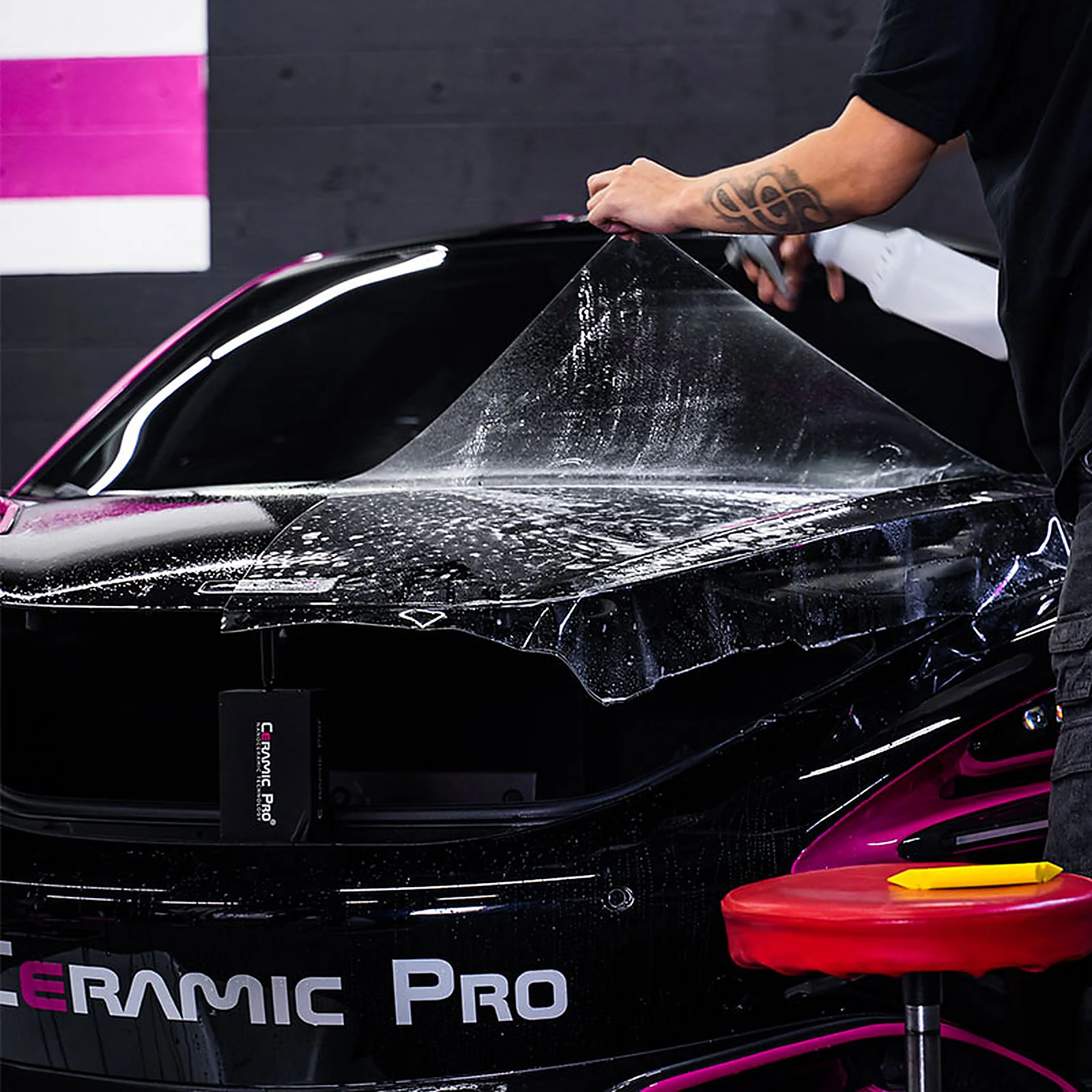

Yes. Paint Protection Film (PPF) can significantly reduce the risk of certain stone-chip impacts damaging your car's original paintwork by providing a flexible protective barrier over covered panels.
When small stones or road debris strike a vehicle, PPF helps absorb and distribute part of the impact before it reaches the paint underneath.
This makes PPF especially worth considering for Malaysian drivers who frequently travel on highways, commute through construction areas or want to preserve their vehicle's factory finish.
The front bumper, bonnet and front fenders are among the most relevant panels for road-debris protection.
However, no protective film can guarantee that every impact will be prevented from damaging the vehicle.
The level of protection depends on the film, impact conditions and installation.
Ceramic Pro Malaysia offers professional stone-chip protection through Ceramic Pro Urban Paint Protection Film, Ceramic Pro Composite Protection Film (CPF) and Magnus Pro PPF.
These systems provide physical paint protection together with modern surface technologies such as self-healing top coats.
This guide explains how PPF works against stone chips, which panels to protect and how to choose an appropriate package for Malaysian driving conditions.
1. Why Do Cars Get Stone Chips?
Stone chips occur when small stones, gravel or other road debris strike a vehicle's painted surface with sufficient force to damage the finish.
The damage may affect the clear coat, colour layer or, in more severe cases, deeper paint layers.
Road Debris from Other Vehicles
During normal driving, vehicle tyres can disturb loose stones and other materials on the road.
Some debris may travel toward surrounding vehicles.
Front-facing body panels are particularly exposed to this type of contact.
Highway Driving
Highway travel can involve higher relative impact speeds between a vehicle and moving road debris.
This makes protection of exposed front-end areas worth considering.
Construction Areas
Roadworks and construction zones may contain loose gravel and road material.
Drivers passing through these areas may encounter additional debris.
Everyday Driving
Stone chips are not limited to highways.
Loose road material can also be encountered on urban roads and ordinary commuting routes.
Why Original Paint Protection Matters
Stone-chip marks can interrupt the painted finish and become visible under certain lighting conditions.
Some damage may require professional paint repair to restore the original appearance.
Protecting exposed surfaces before road impacts occur is a practical way to help preserve the original paintwork.
2. How Does PPF Protect Car Paint from Stone Chips?
Paint Protection Film is a specialised flexible film applied over suitable painted automotive surfaces.
Its main function is to create an additional physical protective layer.
Step 1 — Road Debris Strikes the Film
When a small stone contacts a protected panel, it strikes the film rather than directly contacting the painted surface.
Step 2 — The Film Responds to the Impact
The protective film's material construction is designed to absorb and distribute some of the impact energy.
The response depends on the film's material characteristics and the force of the contact.
Step 3 — The Film Acts as a Sacrificial Layer
The film absorbs some of the external wear that might otherwise reach the original painted finish.
In some cases, the film may show signs of the impact while the paint beneath remains protected.
Step 4 — The Underlying Paint Benefits from the Barrier
When the impact remains within the film's protective capacity, damage to the original paint may be reduced or prevented.
| Impact Stage | Protective Function | Benefit |
|---|---|---|
| Stone approaches painted panel | Protective film covers the surface | Provides an intervening layer |
| Stone contacts the film | Flexible material responds to impact | Helps absorb impact energy |
| Film takes the impact | Sacrificial protective barrier | Reduces direct exposure of paint |
| Impact ends | Film and paint condition depend on severity | May preserve the underlying finish |
The outcome cannot be guaranteed for every impact.
Why the Material Matters
Professional PPF uses flexible protective materials engineered for automotive applications.
The complete film construction influences impact response, clarity, stretch performance and surface durability.
The primary advantage of PPF is providing physical paint protection—not simply improving gloss or water repellency.
3. Which Car Panels Need Stone-Chip Protection Most?
The most useful coverage depends on the vehicle, driving habits and road conditions.
However, some exterior areas are especially relevant for stone-chip protection.
Front Bumper
The front bumper faces the direction of travel.
It is commonly exposed to road debris from vehicles ahead.
PPF protection can help reduce damage from certain minor impacts on the painted bumper surface.
Front Bonnet
The bonnet is another significant area of exposure.
For drivers frequently using Malaysian highways, protecting the bonnet is worth considering.
Front Fenders
Front fenders sit near the exposed front corners of the vehicle.
They can encounter road debris and other everyday driving hazards.
Side Mirrors
Side mirrors are exposed components that may be struck by debris or experience incidental surface contact.
Headlamps
Suitable headlamp protective film can help reduce certain road-impact and surface-related damage.
Compatibility with the lamp material, vehicle design and applicable requirements should be confirmed.
Rocker Panels and Lower Side Sections
Lower body panels can encounter debris and contamination, including material disturbed by the vehicle's own tyres.
Broader protective-film coverage may be appropriate for owners concerned about these areas.
| Vehicle Area | Common Exposure | PPF Worth Considering? |
|---|---|---|
| Front bumper | Forward-facing road debris | Yes |
| Bonnet | Flying stones and road debris | Yes |
| Front fenders | Debris around front corners | Yes |
| Side mirrors | Road debris and everyday contact | Yes |
| Headlamps | Road-debris exposure | Yes, with suitable film |
| Rocker panels | Lower-road debris and contact | Yes, depending on vehicle |
| Side doors | General side-body exposure | Consider broader coverage |
| Rear bumper | Contact and rear-body exposure | Consider broader coverage |
| Roof | Environmental exposure and certain debris | Depends on priorities |
These are practical coverage considerations rather than measured impact-frequency rankings.
For drivers primarily concerned about forward road impacts, the front end is a logical area to prioritise.
4. Is Full Front PPF Enough to Protect Against Stone Chips?
For many Malaysian drivers, Full Front PPF is a practical protection option.
It covers a broader range of forward-facing panels than a basic protection package.
Basic PPF
The published Ceramic Pro Urban and CPF Basic packages include:
- Front bumper.
- Headlamps.
- Side mirrors.
- Door cups.
This provides targeted protection for selected exposed and daily-contact areas.
Full Front PPF
The published Ceramic Pro Urban and CPF Full Front packages include:
- Front bonnet.
- Front bumper.
- Front fenders.
- Headlamps.
- Side mirrors.
- Door cups.
Full Front provides broader protection across the main front-facing painted surfaces.
Full Wrap PPF
Full Wrap extends protection to substantially more exterior panels.
It may suit customers seeking a comprehensive protective film system rather than concentrating primarily on the front end.
Exact inclusions depend on the selected product and vehicle.
Magnus Pro Advance
Magnus Pro also offers an Advance coverage package.
Its panel inclusions must be verified against the current approved package configuration.
| Driving Priority | Package Worth Considering |
|---|---|
| Selected front-impact protection | Basic PPF |
| Front-end stone-chip protection | Full Front PPF |
| Broader original paint preservation | Full Wrap PPF |
| Intermediate Magnus Pro coverage | Advance, subject to verified panel inclusions |
Practical Recommendation
If stone chips on the bonnet and front bumper are your main concern, Full Front PPF is worth exploring.
If you also want protection across lower side panels, doors and rear sections, Full Wrap may be more suitable.
For a full package comparison, read: Full Front vs Full Body PPF: Which Is Better in Malaysia?
Choose the coverage according to the areas most important to you, rather than assuming every vehicle needs identical protection.
5. Can Stone Chips Still Damage a Car with PPF?
Yes. Although PPF is designed to protect painted surfaces, some impacts can exceed its protective capacity.
Understanding this helps set realistic expectations.
Small Road-Debris Impacts
Suitable PPF can absorb certain minor impacts and reduce the likelihood of visible paint damage.
This is one of its principal protective benefits.
Stronger Impacts
Larger stones or high-energy impacts may cause visible damage to the film.
The underlying paint may still remain protected in some circumstances.
Severe Impacts
A sufficiently severe impact may penetrate or damage the film and potentially affect the painted surface beneath.
Does Damage to the Film Mean PPF Has Failed?
Not necessarily.
PPF is intended to function as a sacrificial protective layer.
When an impact damages the film but leaves the original paint unaffected, the film may have performed a valuable protective function.
| Impact Outcome | What It May Mean | Recommended Action |
|---|---|---|
| No visible mark | Film may have absorbed the impact | Continue normal care |
| Fine surface mark | Superficial film-surface contact | Assess under suitable light |
| Visible mark on film | Possible physical film damage | Inspect the affected area |
| Film puncture or tear | Significant physical damage | Contact an installer |
| Underlying paint damage | Impact exceeded protection at that location | Seek paint and film assessment |
Why This Matters
No manufacturer can reasonably guarantee that every possible road impact will be harmless.
PPF helps reduce stone-chip damage risk while preserving the paint whenever the impact remains within the film's protective capability.
6. Does Self-Healing PPF Repair Stone-Chip Damage?
Self-healing technology and impact protection are different characteristics.
Both are useful, but they serve different purposes.
Physical Impact Protection
The body of the protective film provides the barrier that helps absorb certain stone-chip impacts.
Self-Healing Surface Recovery
The film's specialised top coat can help certain fine scratches and swirl marks become less visible under suitable heat conditions.
Can Self-Healing Repair a Deep Stone Impact?
Not necessarily.
If a stone creates a deep cut, puncture or substantial loss of film material, ordinary self-healing cannot regenerate the missing material.
Fine Marks After an Impact
If contact creates only a suitable shallow surface mark, self-healing technology may help reduce its appearance.
The result depends on the mark and film characteristics.
Do Not Apply Aggressive Heat Yourself
Avoid uncontrolled heat guns or other aggressive methods in an attempt to force scratch recovery.
Consult the approved installation centre if the film is visibly damaged.
| Protection Function | Purpose |
|---|---|
| Film impact resistance | Helps protect paint from road-debris strikes |
| Self-healing top coat | Helps suitable fine surface marks recover |
| Hydrophobic surface | Helps manage water and support easier cleaning |
Self-healing supports film appearance. The protective film construction provides the physical barrier against road debris.
For a detailed explanation: How Does Self-Healing Paint Protection Film Work?
7. PPF vs Ceramic Coating: Which Protects Against Stone Chips?
Paint Protection Film and ceramic coating are both professional automotive protection systems.
However, their principal functions differ.
Paint Protection Film
PPF provides a flexible physical barrier over selected painted panels.
It is designed to help absorb certain impacts from stones and road debris.
Ceramic Coating
Ceramic coating focuses on surface characteristics such as gloss, hydrophobic performance, chemical resistance and easier maintenance.
Ceramic Pro 9H provides professional nano-ceramic surface protection.
However, a ceramic coating should not be treated as equivalent to the physical impact protection provided by PPF.
Can PPF and Ceramic Coating Work Together?
Compatible systems can be combined where approved by the manufacturer and professional installer.
Ceramic Pro CPF also incorporates ceramic surface technology into its composite protective film system.
Which Is Better for Stone Chips?
If your main concern is preventing small stones from damaging original automotive paint, PPF is the more relevant protective technology.
If your priority is gloss, water repellency and easier surface maintenance, ceramic coating is worth considering.
| Feature | PPF | Ceramic Coating |
|---|---|---|
| Physical film barrier | Yes | No |
| Designed to absorb certain stone impacts | Yes | Not its primary function |
| Gloss enhancement | Depends on film | Yes |
| Hydrophobic characteristics | Available | Yes |
| Surface maintenance benefits | Yes | Yes |
| Suitable for front-impact protection | Yes | Does not replace PPF |
For the full comparison: PPF vs Ceramic Coating: Which Is Better for Your Car?
8. Should You Install PPF Before Stone Chips Appear?
Installing PPF while the original paint remains in suitable condition is a practical approach to preventive protection.
This is particularly relevant for new-car owners.
Protecting a New Car
A new car often has a relatively fresh factory finish.
Applying suitable PPF early can help reduce exposure of selected painted panels before extensive road use.
Why Surface Condition Matters
Clear PPF is designed to preserve the appearance of the paint beneath it.
Existing damage or imperfections may remain visible after installation.
Vehicle Inspection
Before installation, a professional should inspect the vehicle for:
- Existing stone chips.
- Scratches.
- Surface contamination.
- Previous paint repairs.
- Repainted panels.
- Existing protective coatings.
Professional Preparation
The required preparation depends on the current paint condition.
Not every new car requires extensive correction.
However, appropriate cleaning and inspection remain important.
Early Protection Benefits
For motorists who regularly drive on highways, early front-end coverage can be a practical way to help preserve the original finish.
Applying PPF before significant paint damage occurs gives the film a suitable starting surface and allows protection to begin early in ownership.
For more guidance: Should You Install PPF on a New Car in Malaysia?
9. Can PPF Be Installed Over Existing Stone Chips?
PPF may be suitable for a vehicle with existing paint imperfections, but professional assessment is important.
The film does not restore paint that has already been removed.
Minor Existing Chips
Small existing chips should be assessed before installation.
Depending on the appearance and condition of the paint, preparation or touch-up work may be recommended.
Larger Paint Damage
More significant paint damage may require professional repair before PPF is applied.
The film should not be expected to conceal deep defects or loose paint.
Recently Repainted Panels
Repainted surfaces can have different curing and adhesion requirements.
The installer should follow the relevant paint repairer's and film manufacturer's instructions.
Does PPF Hide Stone Chips?
Clear PPF does not automatically make pre-existing chips invisible.
The visual result depends on the size of the damage, paint colour, surface preparation and film.
Why Professional Assessment Matters
Applying film over unsuitable paint may affect adhesion and the final appearance.
The installer should determine whether the surface is ready for protection.
PPF is most valuable as preventive protection, while existing paint damage should receive appropriate assessment before installation.
10. What Should You Do If a Stone Damages Your Installed PPF?
A significant road impact may leave a visible mark on the film.
The appropriate response depends on whether the damage affects only the film or extends to the underlying paint.
Step 1 — Inspect the Area
Look at the affected panel under suitable lighting.
Avoid picking, scratching or attempting to lift the damaged film.
Step 2 — Clean Gently If Appropriate
Ordinary surface dirt may be removed using the film's approved washing method.
Avoid aggressive rubbing over a visibly damaged section.
Step 3 — Identify the Visible Condition
A mark may be superficial, or it may indicate a deeper cut or puncture.
Visual appearance alone may not reveal whether the underlying paint is affected.
Step 4 — Contact the Installer
An approved installation centre can inspect the film and advise whether further attention is needed.
Step 5 — Discuss Localised Film Replacement
In some circumstances, protective film can be replaced on an individual panel.
This depends on the installed film, panel condition and other relevant factors.
Should You Peel Back the Film to Check the Paint?
No.
Avoid attempting to remove or lift the film yourself.
Professional assessment is preferable, particularly when the paint has been repaired previously.
Is Impact Damage Covered Under Warranty?
Manufacturer warranties generally address specified product conditions under their terms.
External stone-impact damage should not automatically be assumed to qualify as a manufacturing defect.
A professional assessment helps determine whether the protective film needs cleaning, inspection or replacement after a significant road impact.
11. Which Ceramic Pro or Magnus Pro PPF Should You Choose for Stone-Chip Protection?
Ceramic Pro Malaysia offers three professional clear paint protection systems.
All three are designed to provide a physical barrier against everyday road hazards.
Their technologies and ownership benefits differ.
Ceramic Pro Urban PPF — Everyday Impact Protection
Ceramic Pro Urban uses an impact-absorbing TPU protective core combined with a self-healing surface.
It is developed for daily driving and protecting painted surfaces against certain stone chips, fine scratches and road debris.
Published warranty: 3 years, subject to applicable terms.
Urban is worth considering for drivers seeking professional everyday PPF protection.
Ceramic Pro CPF — Composite Protection Technology
Ceramic Pro Composite Protection Film combines physical paint protection with integrated ceramic surface technology.
It is designed to help absorb stone-chip impacts while offering high-gloss and hydrophobic surface characteristics.
Published warranty: 5 years, subject to applicable terms.
CPF may appeal to owners who want physical film protection together with ceramic-style surface-care benefits.
Magnus Pro PPF — Flagship Multi-Layer Protection
Magnus Pro PPF features advanced multi-layer construction incorporating Covalent NanoTech technology.
Its featured film has a published thickness of approximately 8.5 mils.
The system provides physical paint protection together with self-healing and refined surface characteristics.
Published warranty: 6 years, subject to applicable terms.
Magnus Pro is worth considering for customers seeking a flagship protective film system.
Which Is Best for Stone Chips?
All three systems offer relevant physical paint protection.
The right choice depends on:
- Film construction and desired characteristics.
- Vehicle type and driving exposure.
- Selected panel coverage.
- Installation quality.
- Maintenance preferences.
- Warranty considerations.
- Vehicle-specific quotation.
Do not assume one film provides superior measured stone-impact protection without directly comparable testing.
The best PPF choice combines a suitable protective film with the right panel coverage and professional installation.
12. Is PPF Worth It for Frequent Highway Driving in Malaysia?
For drivers regularly travelling on Malaysian highways, front-end PPF is worth considering.
Regular Road-Debris Exposure
Highway driving may expose vehicles to stones and road debris disturbed by surrounding traffic.
This makes front-facing paint protection relevant.
Original Paint Preservation
The protective film helps reduce certain road-impact damage to the covered painted surface.
For owners who value the original factory finish, this can be a meaningful benefit.
Full Front PPF
Full Front coverage protects a broader set of exposed panels than Basic packages.
It may be suitable for customers whose main concern is forward road debris.
Full Wrap PPF
Full Wrap extends protection beyond the front end.
It may be attractive for owners seeking more comprehensive exterior preservation.
Choosing Based on Driving Habits
Consider how frequently the vehicle is used and the types of roads travelled.
There is no universal highway distance or mileage threshold that determines when PPF becomes worthwhile.
Practical Buying Recommendation
If your primary concern is stone chips affecting the bonnet and front bumper, begin by comparing Full Front packages.
If you also want extensive side and rear protection, consider Full Wrap.
For regular Malaysian highway drivers, PPF provides a practical additional barrier against the everyday road-debris risks that concern many vehicle owners.
13. Frequently Asked Questions
14. Final Verdict: Should You Install PPF to Protect Against Stone Chips?
Paint Protection Film is one of the most relevant professional automotive protection options for reducing the risk of stone-chip damage to original paintwork.
Its flexible physical construction provides a sacrificial protective barrier over selected exterior panels.
For Malaysian drivers, particularly those regularly using highways, the bonnet, front bumper and front fenders are logical areas to prioritise.
Full Front PPF offers a practical way to protect these exposed sections.
Full Wrap provides a more extensive approach for customers who want broader exterior paint preservation.
Ceramic Pro Malaysia offers professional protection through Ceramic Pro Urban, Ceramic Pro CPF and Magnus Pro PPF, allowing customers to choose different film technologies and coverage packages.
While no film can guarantee protection against every impact, a suitable PPF system can provide meaningful preventive protection during everyday ownership.
The best result begins with professional paint assessment, appropriate coverage and careful installation.
PROTECT YOUR ORIGINAL PAINT. DRIVE WITH CONFIDENCE.
Explore Ceramic Pro and Magnus Pro Paint Protection Film and request a personalised recommendation for your vehicle.
About This Guide
This guide is published by Ceramic Pro Malaysia to help vehicle owners understand how paint protection film reduces stone-chip damage risks.
The product-specific information is based on official Ceramic Pro Urban, Ceramic Pro CPF and Magnus Pro documentation.
The explanations describe the intended physical protective function of suitable automotive PPF systems.
They are not independently measured comparative stone-impact test results.
Actual protection depends on film construction, impact conditions, installation and panel coverage.
The guide does not guarantee that every stone impact will be prevented or that any particular impact will leave the underlying paint undamaged.