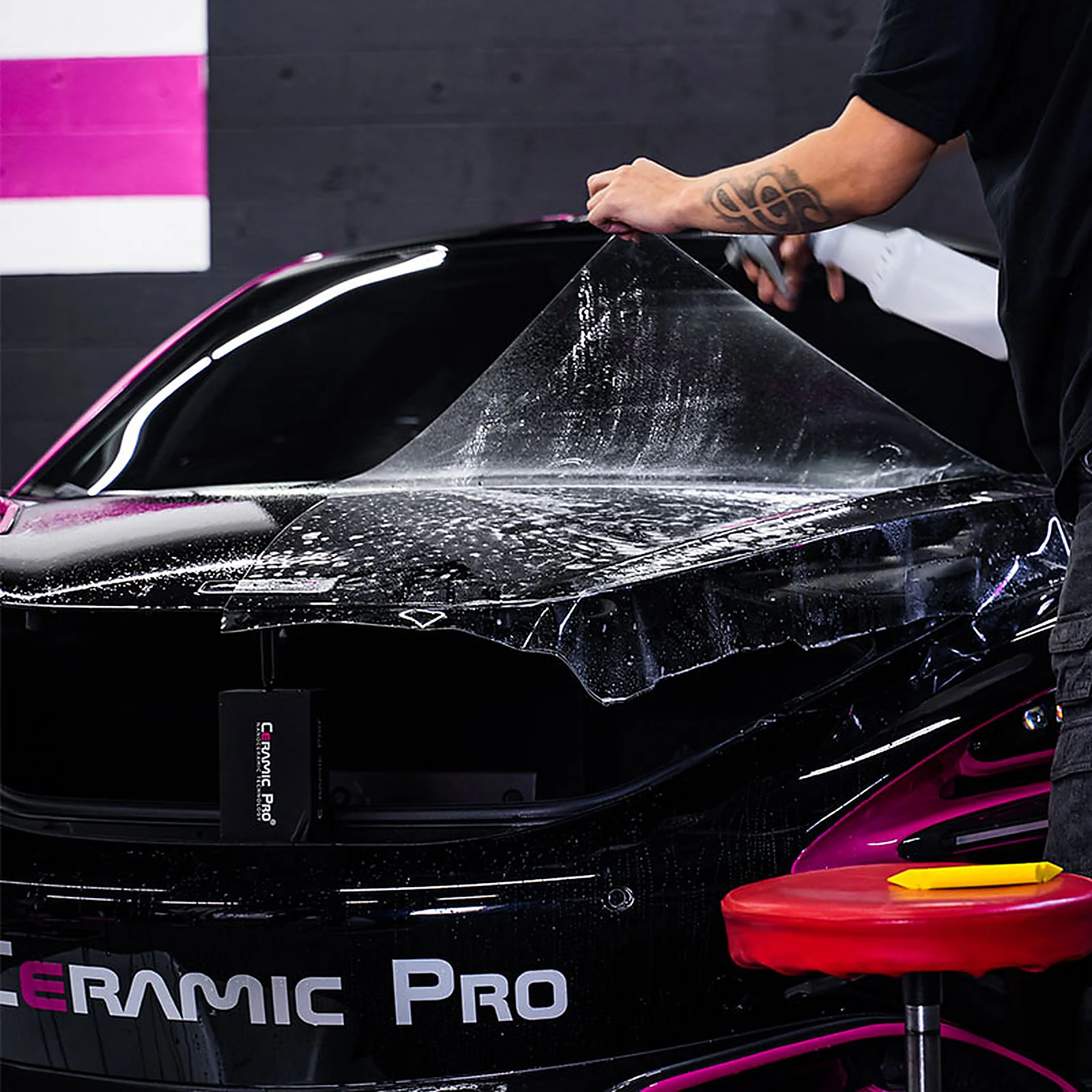

Paint protection film can help preserve your vehicle's original paint against stone chips, light scratches and everyday road exposure.
But two films that look almost identical when newly installed may be manufactured from different materials.
Some installers advertise TPU. Others use terms such as TPH or PVC.
Understanding these materials matters because flexibility, optical clarity, resistance to ageing and surface performance depend on the complete film construction—not simply the appearance of a new roll.
For Malaysian drivers, the decision also involves heat, sunlight, humidity, highway travel, installation quality and long-term maintenance.
This guide explains the material differences, what buyers should verify and how to evaluate a quality PPF system before committing to an installation.
The essentials
Key takeaways
TPU is a defined polymer family.
Thermoplastic polyurethane is widely used in modern automotive paint protection film because suitable grades can provide flexibility, elasticity and a resilient protective barrier.
TPH requires clarification.
TPH is used as a commercial film label with varying descriptions and formulations. Buyers should ask what polymer actually forms the film's protective body.
PVC is a different polymer.
Polyvinyl chloride is used in a variety of flexible films, but PVC construction alone does not establish suitability for premium, long-term automotive paint protection.
Self-healing depends on the surface system.
Not every TPU film is self-healing, and the base polymer name does not prove how a particular film's topcoat will recover from fine scratches.
Evaluate the complete product.
Base material, film construction, optical performance, ageing resistance, installation quality, warranty and verified testing matter more than marketing labels alone.
01 — WHAT IS TPU, TPH AND PVC PPF?
Three Names. Not Three Equivalent Material Standards.
Paint protection film, commonly known as PPF, is applied over compatible automotive exterior surfaces to provide a physical protective layer.
It is often clear, although coloured protective films are also available.
The film is designed to take some of the contact from road debris, minor abrasion and environmental exposure before those hazards reach the paint underneath.
However, the polymer used to make the film body can vary.
TPU — Thermoplastic Polyurethane
TPU is a defined family of thermoplastic elastomers.
Suitable formulations can offer a combination of flexibility, elasticity and physical resilience, making them useful in modern protective film applications.
TPH — A Commercial Film Description
TPH is used in automotive film marketing, often described as a thermoplastic hybrid or a modified film construction.
Unlike TPU or PVC, it should not be assumed to identify one consistent polymer chemistry across every manufacturer.
Some suppliers describe TPH products as PVC-associated or modified PVC films.
Other manufacturers may define the term differently.
The correct approach is to request the specific product's material declaration.
PVC — Polyvinyl Chloride
PVC is a defined polymer widely used in flexible film and vinyl products.
Its properties depend on formulation, plasticizers, stabilizers, surface treatments and manufacturing processes.
PVC-based materials can serve different decorative and protective purposes, but they should not automatically be treated as equivalent to TPU-based automotive PPF.
The Key Distinction
TPU and PVC identify recognized polymer families.
TPH, as encountered in PPF sales, requires the manufacturer's actual definition.
The most useful question is not which acronym sounds more premium. It is what material and complete film system the installer is supplying.
02 — WHAT IS TPU PAINT PROTECTION FILM?
Why Polyurethane Is Widely Used for Automotive Protection.
Thermoplastic polyurethane can combine flexibility with useful mechanical properties, as documented across industrial references such as ORAFOL — Advanced TPU Films.
For automotive film applications, suitable TPU materials can be formed into transparent sheets that follow the contours of complex vehicle panels.
This combination of flexibility and resilience is particularly useful for bumpers, bonnets, fenders and other curved areas.
Modern protective films may also use specialized topcoats, adhesive systems and additional functional treatments.
Flexibility and Conformability
Vehicle body panels are rarely completely flat.
A flexible film can be positioned and shaped around curves without behaving like a rigid sheet.
The actual installation capability depends on the TPU formulation, film thickness, adhesive and professional technique.
Resilience Against Everyday Contact
A TPU protective film can create a physical layer between road hazards and the original paint.
It may help reduce the severity of some stone-chip impacts and minor abrasion.
Sufficiently severe contact can still tear or penetrate the film.
Optical Appearance
High-quality clear TPU films can be engineered for transparency and consistent gloss.
However, the final appearance also depends on the topcoat, adhesive, manufacturing quality and installation.
The TPU label alone cannot guarantee excellent optical clarity.
Outdoor Weatherability
Some automotive-grade TPU systems use material chemistry and additives selected for outdoor exposure.
Aliphatic TPU formulations are often preferred where colour stability and resistance to certain weathering effects are important.
Nevertheless, not every TPU formulation has identical ageing behaviour.
Does TPU Automatically Mean Premium PPF?
No.
Two TPU films may use different grades, surface coatings, adhesive systems and quality-control procedures.
They may also have different test results and warranty conditions.
TPU is a meaningful starting point, but the complete product must still be evaluated.
03 — WHAT DOES TPH PPF ACTUALLY MEAN?
Understand the Label Before Trusting the Claim.
TPH is one of the more confusing expressions used in paint protection film marketing.
It is often positioned between entry-level vinyl-style products and premium TPU film.
Some suppliers describe TPH as a modified or hybrid construction, frequently associated with PVC-based materials.
However, the term does not consistently identify one universal recipe.
It should not be assumed that every film marketed as TPH contains the same blend, the same topcoat or the same protective characteristics.
Why the Term Matters
A customer may hear that a TPH film is:
- Similar to TPU.
- A hybrid protective material.
- More affordable than premium PPF.
- Flexible enough for automotive installation.
- Equipped with a self-healing surface.
These statements may refer to particular products, but they do not prove the material composition or performance of every film carrying the TPH label.
Is TPH Always the Same as PVC?
No universal equivalence should be asserted without the manufacturer's material declaration.
Some technical classifications—including industry reference frameworks such as QC/T 1171-2022 (a Chinese automotive industry standard referenced for classification context rather than a Malaysian regulatory requirement)—and suppliers group TPH-labelled products with PVC-based film constructions, while commercial descriptions can differ.
This is why a buyer should ask for the actual base polymer and relevant product specifications.
Can TPH Offer Useful Protection?
Potentially, depending on the individual product and the exposure it is designed to withstand.
However, marketing descriptions do not establish long-term optical stability, impact resistance or self-healing performance.
Those qualities require specific supporting evidence.
What Should You Ask the Installer?
Ask:
"What polymer forms the main protective film body, and can you show the manufacturer's technical specification?"
A credible supplier should be able to identify the product, explain its intended use and provide supporting documentation.
If the only information offered is the term "TPH" without a manufacturer or material specification, there is insufficient evidence for a confident long-term performance comparison.
04 — WHAT IS PVC PAINT PROTECTION FILM?
A Different Material With Different Design Considerations.
Polyvinyl chloride is a widely used polymer found in numerous flexible film products.
Its characteristics can be adjusted through formulation and manufacturing.
PVC is commonly associated with vinyl film applications, including certain decorative automotive wraps.
However, not every PVC-based film is manufactured for the same purpose.
Flexibility
Some PVC formulations use plasticizers to achieve desired flexibility.
Material behaviour can change with formulation, exposure and ageing.
This can matter when a film is installed over complex shapes and exposed to outdoor conditions for extended periods.
Appearance and Colour Stability
Clear automotive protection requires good optical properties.
The long-term appearance of a PVC-based film depends on stabilizers, formulation, surface layers and exposure.
It would be inaccurate to claim that every PVC film immediately yellows or fails.
It would also be inaccurate to assume that any PVC product performs like a verified premium TPU paint protection film.
Protective Capability
A PVC-based film may provide some physical separation from light contact and environmental contaminants.
The level of impact and abrasion protection depends on its actual construction.
A decorative vinyl wrap should not automatically be sold or understood as offering the same protection as a purpose-engineered automotive PPF.
Where PVC Films May Be Appropriate
PVC-based products can be useful in applications where visual customization, price, service period and specific material characteristics are the main priorities.
For owners seeking premium long-term protection of original exterior paint, a purpose-designed automotive PPF with documented mechanical, optical and ageing performance deserves careful consideration.
05 — TPU VS TPH VS PVC: THE PRACTICAL COMPARISON
Compare the Material You Are Actually Buying.
The following table explains the meaningful differences while recognizing that individual film products can vary considerably.
Material Comparison
| Factor | TPU | TPH | PVC |
|---|---|---|---|
| Material identity | Defined thermoplastic polyurethane family | Commercial label; formulation must be verified | Defined polyvinyl chloride family |
| Common positioning | Modern automotive protective film | Often marketed as a modified or hybrid film | Vinyl and other flexible-film applications |
| Flexibility | Can be highly flexible and elastic | Depends on actual composition | Depends on formulation and plasticizers |
| Surface self-healing | Available with suitable topcoat | Must be verified for each product | Must be verified for each product |
| Optical clarity | Can be engineered for high transparency | Product-dependent | Product-dependent |
| Weathering resistance | Grade, additives and film system matter | Product-dependent | Formulation and stabilizers matter |
| Stone-chip protection | Depends on complete protective construction | Requires specific evidence | Requires specific evidence |
| Long-term suitability | Automotive-grade systems are widely used | Requires verification | Requires verification |
| Buying priority | Check grade, topcoat, adhesive and tests | Identify actual polymer and tests | Check intended use and tests |
How Should This Table Be Interpreted?
It is a comparison of material categories, not laboratory results comparing three specific commercial films.
A well-designed TPU system may offer important advantages for professional automotive protection.
However, a poor TPU product cannot be assumed to outperform every properly engineered alternative.
Similarly, a TPH or PVC label alone is insufficient to determine a specific product's useful service life.
The strongest comparison uses identifiable products tested under comparable conditions.
06 — WHY THE FILM LAYERS MATTER MORE THAN THE NAME
A Modern Protective Film Is a Complete System.
The base polymer is important, but the owner experiences the performance of the finished film—not an isolated sheet of raw material.
A typical automotive paint protection system includes several functional elements. For how physical gauge interacts with layer design, see our PPF thickness guide in Malaysia.
1. Surface Topcoat
The topcoat influences the film's appearance and surface behaviour.
Depending on the product, it may provide characteristics such as self-healing, hydrophobic behaviour, gloss or resistance to certain contaminants.
A TPU body does not automatically mean that a film has a self-healing topcoat.
2. Protective Film Body
The main polymer layer contributes much of the film's flexibility and physical barrier properties.
For modern TPU-based protective films, this layer helps the film conform to body panels and respond to selected mechanical contact.
3. Adhesive System
The adhesive secures the protective film to an appropriately prepared surface.
Its characteristics influence installation, adhesion, appearance and removal.
A film with excellent surface properties but an unsuitable adhesive system may still produce a poor result.
4. Temporary Protective Liners
Liners help protect the film and adhesive during handling and application.
They are normally removed during installation.
They must not be counted as permanent protective layers on the vehicle.
Why Construction Matters
| Film component | Main responsibility |
|---|---|
| Topcoat | Surface appearance, selected scratch recovery and cleaning characteristics |
| Base film | Physical barrier, flexibility and mechanical properties |
| Adhesive | Bonding to compatible vehicle surfaces |
| Temporary liners | Protection during handling and installation |
Actual designs differ between manufacturers.
A premium PPF should be evaluated as a complete film-and-adhesive system, not simply by the main polymer name or number of advertised layers.
07 — SELF-HEALING, YELLOWING AND LONG-TERM PERFORMANCE
Three Features Worth Investigating Separately.
Customers often assume that every film advertised as premium provides self-healing, colour stability and long-term protection.
These are different properties and should be evaluated independently.
Self-Healing
Self-healing refers to the ability of a suitable film surface to recover from certain superficial scratches. For a closer look at heat-activated surface recovery, read how self-healing PPF works.
Some topcoats respond to warmth, which can allow fine swirl marks to become less visible.
This does not mean deep cuts, punctures or damaged paint will repair themselves.
A supplier should identify whether the specific film includes a self-healing surface and provide appropriate evidence.
Yellowing and Colour Change
Outdoor films are exposed to sunlight, heat, moisture, atmospheric contaminants and cleaning chemicals.
Over time, unsuitable materials or poorly designed film systems may experience colour changes or other appearance problems.
Polymer chemistry can influence this behaviour.
However, yellowing resistance depends on the finished product, not simply the TPU, TPH or PVC label.
Malaysia's Climate
Malaysian cars can experience repeated sunlight exposure, high humidity, rain, road grime and frequent washing.
These conditions make long-term film appearance and maintenance particularly relevant.
But temperature and humidity alone do not predict precisely how many years any given film will last.
What Evidence Is Useful?
Look for documented testing of:
- Accelerated weathering.
- Optical clarity and haze.
- Yellowing or colour change.
- Gloss retention.
- Adhesion.
- Tensile and elongation characteristics.
- Tear or puncture resistance.
- Surface scratch recovery.
- Chemical or stain resistance where relevant.
Test methods, test conditions and acceptance criteria matter.
An impressive numerical result without a stated test method may be difficult to interpret.
Accelerated ageing results are not automatically equivalent to a guaranteed number of real-world years in Malaysia.
08 — HOW CAN YOU VERIFY A QUALITY PPF?
Ask for Evidence, Not Just a Sales Description.
A PPF installation may represent a meaningful investment.
Before choosing, ask the installer for information that identifies the actual product and supports its claims. For installer evaluation criteria, see how to choose a PPF installer in Malaysia.
Confirm the Manufacturer and Film Series
A recognizable brand is useful, but the exact film series matters.
Different products from the same company can have different formulations, thicknesses, warranty periods and intended applications.
Ask About the Base Polymer
For TPU, ask whether the manufacturer identifies the actual TPU construction and relevant material characteristics.
For TPH, ask the supplier to clarify what the term means in that specific product.
For PVC, confirm whether the film is intended for exterior automotive paint protection or primarily decorative wrapping.
Review the Topcoat
Check whether self-healing, hydrophobic behaviour and other surface features are actually specified.
Do not assume every film contains these technologies.
Request Technical Documentation
Manufacturer specifications and appropriately documented test reports are more useful than unsupported claims.
Where third-party testing is cited, check the laboratory, product tested, scope, methods and reported results.
Understand the Warranty
A longer warranty period is not the same as proof that a film resists more stone-chip impacts.
Check exactly what defects are covered, which conditions apply and what events are excluded—for example on the Ceramic Pro Malaysia After Care & Warranty page.
Confirm the Installation
The film must also be installed correctly.
Professional preparation, accurate fitment and suitable edge finishing can affect the finished appearance and performance.
PPF Buyer Verification Checklist
- Film manufacturer and exact product series identified.
- Base polymer clearly explained.
- Actual film specification available.
- Topcoat characteristics documented.
- Film thickness and measurement basis understood.
- Relevant test evidence available.
- Warranty scope and exclusions explained.
- Vehicle coverage confirmed in writing.
- Installer's experience and procedures understood.
- Aftercare requirements supplied.
When a claim cannot be verified, treat it as unconfirmed—not automatically true or false.
09 — CERAMIC PRO AND MAGNUS PRO: MATERIAL QUALITY IN PRACTICE
Three Film Systems. Different Protection Priorities.
Ceramic Pro Malaysia offers several professionally installed protective film systems across its Paint Protection Film range.
Their differences are better understood through published construction, surface technology, coverage and warranty information than through generic claims that every premium film is identical. For a broader brand overview, see our PPF brands comparison in Malaysia.
Ceramic Pro Urban PPF
TPU protection for everyday driving.
Ceramic Pro Urban uses a TPU protective core and a self-healing surface system intended for practical everyday paint protection.
Its official product page identifies:
- A TPU-based protective structure.
- Self-healing topcoat.
- Approximately 7 mil nominal film thickness, with published metric specifications around 185 microns.
- Three-year limited manufacturing-defect warranty.
- Published SGS performance-testing information.
Urban is designed for owners who want practical physical protection against selected everyday road hazards.
Its SGS testing information gives buyers a useful example of the type of supporting documentation that can be examined when evaluating a film, while recognizing that a test certificate alone does not establish superiority over another manufacturer's film without equivalent comparison data.
Official product: Ceramic Pro Urban PPF
Ceramic Pro Composite Protection Film (CPF)
Physical film protection with integrated ceramic surface technology.
Ceramic Pro CPF combines paint protection film with manufacturer-described Flexible Ceramic Composite Technology (FCCT) and ION ceramic surface technology.
Published Malaysian information identifies:
- A protective film with ceramic-related surface technology.
- Approximately 8 mil / 205 microns nominal thickness.
- Self-healing surface characteristics.
- Hydrophobic behaviour intended to support easier maintenance.
- Five-year limited manufacturing-defect warranty.
- Applicable complimentary maintenance sessions under published package terms.
CPF may appeal to drivers who want physical paint protection together with its ceramic composite surface characteristics.
Its material benefits are best evaluated through verified product documentation rather than unsupported claims about exact molecular composition or superiority.
Official product: Ceramic Pro CPF
Magnus Pro Paint Protection Film
Flagship multilayer protective film.
Magnus Pro's featured paint protection film is designed for physical paint protection, surface recovery and clear exterior appearance.
Published Malaysian information identifies:
- Featured thickness of 8.5 mil / approximately 215 microns.
- Multilayer protective construction.
- Covalent NanoTech (CNT) positioning.
- Self-healing surface characteristics.
- Hydrophobic finish.
- Six-year limited manufacturing-defect warranty.
Film characteristics can vary by Magnus Pro variant, so buyers should review the exact product documentation rather than assume every Magnus Pro film uses identical polymer formulations or specifications.
Official product: Magnus Pro PPF
Product Summary
| Product | Published positioning | Featured thickness | Published warranty |
|---|---|---|---|
| Ceramic Pro Urban | Everyday TPU protective film | Approx. 7 mil | 3 years |
| Ceramic Pro CPF | Composite film with ceramic surface technology | Approx. 8 mil | 5 years |
| Magnus Pro PPF | Flagship multilayer protective system | Approx. 8.5 mil | 6 years |
Warranty coverage applies to specified manufacturing defects under the relevant terms.
These specifications are not standardized comparative performance test results.
Which Should You Consider?
Urban is a logical starting point for owners seeking everyday physical paint protection.
CPF is relevant when integrated ceramic surface characteristics and the Ceramic Pro system are particular priorities.
Magnus Pro deserves consideration when the owner prefers its published flagship construction and ownership offering.
The correct choice depends on the actual product, vehicle, protection goals and installation package—not thickness or marketing terminology alone.
10 — WHY INSTALLATION QUALITY STILL MATTERS
Even a Good Film Needs the Right Application.
Paint protection film is installed onto the actual surfaces of a vehicle.
Curved bumpers, panel edges, body contours and existing paint condition can all influence installation.
A suitable process generally includes:
Vehicle Assessment
The installer checks the condition and compatibility of the surfaces to be protected.
Existing defects, repainting and contamination should be considered before film application.
Surface Preparation
The vehicle is cleaned and prepared according to the intended film and installation procedure.
Proper surface preparation helps support adhesion and the final appearance.
Film Positioning
The film is fitted using suitable professional methods and approved application materials.
The exact procedure depends on the manufacturer and vehicle.
Edge Finishing
Panel edges and complex areas require attention to alignment and adhesion.
Final Inspection
The installation is inspected for visible defects, fitment and finishing quality.
Settling and Aftercare
New installations may require a settling period.
Owners should follow the film-specific instructions in After Care & Warranty and arrange professional inspection if abnormal lifting, contamination or defects develop. For ongoing routine washing, Auto Bath Club is also available as an optional car-care service.
The best result combines appropriate film selection with competent installation and proper maintenance.
For real local installation examples in Garage Journal, see verified Malaysian vehicles including the Honda Civic Type R FL5 — Ceramic Pro CPF Full Wrap, the BMW M3 Competition Touring — Magnus Pro PPF Full Wrap and the Porsche 911 GT3 — Magnus Pro PPF Full Wrap.
11 — WHICH PPF SHOULD MALAYSIAN DRIVERS CHOOSE?
Match the Film to the Vehicle and Ownership Priorities.
There is no single PPF recommendation that suits every vehicle.
The intended driving environment, desired coverage and maintenance expectations all matter.
For a New Daily-Driven Car
A professionally installed TPU-based PPF system is worth considering when the owner wants to help protect the original finish against everyday road exposure.
Ceramic Pro Urban may be relevant for drivers seeking its published everyday protective characteristics.
For Frequent Highway Travel
Stone chips and road debris often affect forward-facing panels.
Film quality matters, but so does choosing appropriate coverage around the bumper, bonnet and front fenders.
Ceramic Pro CPF and Magnus Pro PPF may be considered alongside Urban, depending on the owner's expectations.
For Owners Prioritizing Surface Maintenance
A film with documented hydrophobic characteristics may be attractive to owners who want convenient routine cleaning.
Ceramic Pro CPF's ceramic surface technology is relevant to this decision.
For Premium and Performance Vehicles
Owners prioritizing original paint appearance may prefer comprehensive protection and careful installation.
Consider the film's documented characteristics and the experience of the installer rather than relying solely on a polymer label.
For Budget-Conscious Buyers
Avoid assuming that the lowest price represents the best long-term value. For typical coverage tiers and cost factors, see our PPF price guide in Malaysia.
Compare product identification, documented construction, panel coverage, installation workmanship, warranty conditions and aftercare support.
A smaller package using a verified film may be more useful than broad coverage using a poorly documented product.
Malaysia-Specific Considerations
Owners should consider:
- Highway stone-chip exposure.
- Frequent rainfall and road grime.
- Outdoor parking.
- Washing frequency.
- Vehicle body design.
- Long-term maintenance expectations.
- Local installer availability.
These factors influence the practical buying decision, and visiting an approved Ceramic Pro Malaysia location allows you to inspect sample films and confirm the exact film series supplied for your vehicle.
They do not justify unsupported claims that one polymer will always outperform another in every Malaysian condition.
12 — FINAL VERDICT: WHAT REALLY MAKES A GOOD PPF?
Choose the Film System, Not Just the Acronym.
TPU is widely used in modern premium automotive paint protection because appropriate formulations can provide the flexibility and resilience needed for protective-film applications.
TPH deserves more careful interpretation because the term is used inconsistently across different suppliers.
PVC is a recognized polymer with numerous film applications, but a PVC label alone does not establish suitability for premium long-term automotive paint protection.
For a Malaysian owner, the most important decision is not simply choosing the most impressive-sounding material name.
It is choosing a verified film system that matches the desired protection, vehicle condition and ownership needs.
A good PPF should have identifiable construction, documented performance characteristics, appropriate adhesive and surface technology, professional installation and clear warranty terms.
Ceramic Pro Urban, Ceramic Pro CPF and Magnus Pro PPF offer different documented protective technologies and ownership characteristics.
Each should be evaluated on its actual specifications.
A quality paint protection film should be chosen through evidence, not assumptions.
When you understand the material, the complete film and the installer behind it, you can make a more confident decision about protecting your vehicle's original paint.
Frequently Asked Questions
Sources and Further Reading
- Ceramic Pro Malaysia — Paint Protection Film
Source for the published Malaysian film systems, product positioning and headline specifications.
- Ceramic Pro Urban PPF
Source for Urban's TPU structure, self-healing technology, published thickness, warranty and SGS test summary.
- Ceramic Pro Composite Protection Film
Source for CPF's film and ceramic composite technology.
- Magnus Pro Paint Protection Film
Source for featured film specifications, construction positioning and warranty.
- Ceramic Pro Malaysia — After Care & Warranty
Source for applicable warranty and maintenance conditions.
- ORAFOL — Advanced TPU Films
Industrial materials reference explaining TPU-film properties and applications; product-specific claims on that page are not test results for Ceramic Pro or Magnus Pro.
- QC/T 1171-2022 — Automotive Paint Protection Film
Contextual reference to a third-party English presentation of a Chinese automotive industry standard framework, not a Malaysian regulatory requirement; no unverified numerical standard provisions are asserted.